|
|
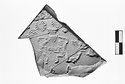
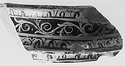
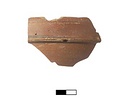
Rim fragment.
Rime zone: alternating sequence of rosettes and fronds rising from a line of double spirals above a band of egg and dart which in bounded above and below by a plain ridge. East end Of East ... 14 June 1934 ... Mould for Megarian Bowls |
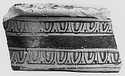
Rim fragment.
Rim zone: small fronds rising from a line of double spirals above a band of simple guilloche. WT 268.
Wall Trench δ5, surface earth. 1590 ... 24 August 1937 ... Mould for Megarian Bowls |
Rim fragment.
Rim zone: small fronds rising from a line of double spirals above a band of guilloche; two plain ridges between spirals and guilloche. East end of East Stoa, original red filling along south ... 26 June 1934 ... Mould for Megarian Bowls |
Clay: dull buff containing very firm grains of grit and mica. East Stoa; from the uppermost filling of the southern part (trench ι, south part) ... October 1932 ... Mould for Megarian Bowls |
Clay: pale yellow, fine, soft.
Rim zone: band of inverted palmettes below, the tip of a small frond and of something else of the right. Trench Θ, north half ... October 1932 ... Mould for Megarian Bowls |
Clay: yellow-green, containing very fine air holes. Trench Θ, northern half ... October 1932 ... Mould for Megarian Bowls |
Clay: fine, buff.
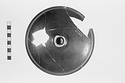
One quadrant of base and part of side wall remains.
Medallion of base probably plain, surrounded by two raised lines from which radiate narrow channels punctuated by dots and separated ... 1931 ... Mould for Megarian Bowls |
Two joining fragments, preserving part of base and wall.
Wall: long petals with jeweled lines between. Northeast corner of East Stoa, beneath firm white strosis ... 12 June 1934 ... Mould for Megarian Bowls |
Clay: Buff, fine. Assembly Place, surface ... 1931 ... Mould for Megarian Bowls |
Clay: bright buff inside, dull on surface, fine; containing minute grains of mica. Trench Θ, north half ... October 1932 ... Mould for Megarian Bowls |
Clay: Buff, fired to yellow on outer surface, fine. Another fragment, also from the rim, has been found to join with this. East Stoa, from the late filling along the north face of the city wall (Trench ... October 1932 ... Mould for Megarian Bowls |
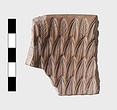
Three rim fragments, non-joining.
Long petals alternating with jeweled lines which end above in small fronds; above the petals are two plain ridges. East end of East Stoa, original red filling along south ... 29 June 1934 ... Mould for Megarian Bowls |
Rim fragment.
Rim zone: a band of ovules with double outline bounded above and below by a plain ridge.
Wall: there remains the lip of a long petal and a small frond belonging to an intermediate jeweled ... 30 June 1934 ... Mould for Megarian Bowls |
Part of base and wall, the outside entirely flaked away.
Medallion: plain, surrounded by two ridges .
Wall: long petals, plain between. East end of East Stoa, south side, Layer II ... 30 June 1934 ... Mould for Megarian Bowls |
Clay: Buff, fine, hard, oily on the inner surface. One joining and one non-joining fragment added later. East Stoa, from the filling behind the terrace wall (Trench τ, north part) ... October 1932 ... Mould for Megarian Bowls |
Rim fragment only.
Rim zone: band of egg and dart with one plain ridge above and two below.
Wall: plain long petals set close. East end of East Stoa, disturbed surface ... 5 June 1934 ... Mould for Megarian Bowls |
Clay: Buff inside, faded yellow outside, fine with very small particles of mica. East Stoa, filling behind the terrace wall ... 1931 ... Mould for Megarian Bowls |
Clay: Mottled in color, light yellow to buff, firm; retaining on its inside surface traces of an oily application. East Stoa, from the clearing north of the terrace wall ... October 1932 ... Mould for Megarian Bowls |
Clay: Pale buff, containing some fine grit.
Rim Zone: Masks alternating with sitting birds (?).
Wall: Slight and uncertain traces.
From a notably straight walled bowl Assembly place, clearing north of ... 1931 ... Mould For Megarian Bowls |
Part of base and side wall.
Medallion: probably a small rosette, surrounded by 5 rows of fronds and by a row of flying birds.
Wall: there remain Eros with torch and a large flying bird. East Stoa, northeast ... 12 June 1934 ... Mould for Megarian Bowls |
Base and part of wall.
Medallion: broken away; surrounded by triangular groups of fronds.
Wall: legs of a large figure moving left.
Wheel marks are fresh both inside and outside suggest that this is an ... 30 July 1937 ... Mould for Megarian Bowls |
| Clay: bright buff, hard and firm, retaining traces of oil on its inner surface. Another non-joining fragment added in 1934? East Stoa, from the filling behind the terrace wall, (Trench ι, north part, above ... October 1932 ... Mould for Megarian Bowls |
Fragment from rim.
Rim gone: a close set line of fronds, tips down above a line of double spirals from which depend at intervals small palmettes. East Stoa, northeast corner, beneath firm white floor ... 12 June 1934 ... Mould for Megarian Bowls |
Fragment from rim.
Rim zone: band of egg and dart above a guilloche.
On the wall there remains an arec flower. East Stoa, east end, layer II, beneath firm white floor ... 21 June 1934 ... Mould for Megarian Bowls |
Fragment from rim.
Rim zone: a line of double spirals above a line of ovules with double outline.
Wall: the remains a running bird within a dotted semicircle. WT 309.
Wall Trench T, disturbed filling south ... 28 August 1937 ... Mould for Megarian Bowls |
Clay: buff; fine, containing minute grains of mica. East Stoa; from the uppermost filling of the southern part (trench ι, south part) ... October 1932 ... Mould for Megarian Bowls |
Wall fragment, broken all around.
Rim zone: along its lower edge a line of ovules.
Wall: there remain a flying bird and part of a grape cluster? East Stoa, east end, Layer II, beneath firm white floor ... 16 June 1934 ... Mould for Megarian Bowls |
Clay: buff, yellow on the inner surface; fine and hard. East Stoa; clearing to the north of the terrace wall ... October 1932 ... Mould for Megarian Bowls |
Clay: buff, fine. Another non-joining fragment added later. East Stoa; clearing to the north of the terrace wall ... October 1932 ... Mould for Megarian Bowls |
Clay: buff, creamy of the inner surface; fine and hard. East Stoa; clearing the course of the terrace wall ... 1931 ... Mould for Megarian Bowls |
Two joining fragments from rim.
Rim zone comprises a line of palmettes above double spirals, above a beaded line, above egg and dart.
Wall: there remains the tips of lotus leaves with arec flowers between ... 16 June 1934 ... Mould for Megarian Bowls |
Two joining fragments from rim.
No rim zone.
On wall tall fronds alternated with lotus leaves, on lower wall are tips of lotus leaves from a calyx around base ? To east of east end of East Stoa, down to ... 16 June 1934 ... Mould for Megarian Bowls |
Wall fragment broken all around.
On wall there remains a broad leaf with jeweled mid rib; a daisy and other indeterminate space fillers between. WT 160.
Wall trench Q, Layer II, content of early III century ... Mould for Megarian Bowls |
Wall fragment broken all around.
On wall there remains part of a lotus leaf of a tendril. Northeast corner of East Stoa, beneath level of firm white strosis, where strosis was disturbed ... 15 June 1934 ... Mould for Megarian Bowls |
Wall fragment broken all around.
Rim zone: two double spirals remain.
Wall: tip of a large front with jeweled mid rib and tip of a smaller frond. Northeast corner of East Stoa, Layer II, beneath firm white ... 19 June 1934 ... Mould for Megarian Bowls |
Wall fragment retaining part of base ring.
Wall: covered by overlapping broad lotus (?) leaves.
On inner surface are fresh traces of graver. Southeast corner of East Stoa, from deepest red filling ... 12 June 1934 ... Mould for Megarian Bowls |
Non-joining fragments, one from base and two from wall.
Wall so far as preserved is covered by overlapping short fronds. East end of East Stoa, Layer II, beneath strosis ... 16 June 1934 ... Mould for Megarian Bowls |
Clay: red, buff on outer surface, fine and hard. Small non-joining wall fragment added later. East Stoa; from the upper filling of the south part of the area (trench ι , 8 m. from its south end) ... October 1932 ... Mould for Megarian Bowls |
Non joining fragments; one from rim, one from wall.
Rim zone: guilloche with one plain ridge above and two below.
Wall: covered with nodules as of a fine cone. East end of East Stoa; original red filling ... 29 June 1934 ... Mould for Megarian Bowls |
Wall fragment broken all around.
Wall: covered with nodules as of a fine cone. WT 270.
Wall Trench K, Layer III, content of early II century. 1264 ... 30 July 1937 ... Mould for Megarian Bowls |
Clay: buff inside; yellow outside; fine.
Medallion: head of Athena in Attic helmet surrounded by two rows of small fronds. East Stoa; filling behind the terrace wall ... 1931 ... Mould for Megarian Bowls |
Base and start of wall remains.
Medallion: a gorgoneion, very faint.
Wall: as preserved, covered by short, overlapping fronds.
Surface much rubbed. WT 269.
Wall Trench S2; red earth and debris to bedrock ... 23 July 1937 ... Mould for Megarian Bowls |
Clay: buff, fine, hard, retaining traces of oil on its inner surface. East Stoa; clearing north of the terrace wall ... October 1932 ... Mould for Megarian Bowls |
Clay: fine, buff, very slightly micaceous
The base is complete and retains a fragment of the side wall. On the base a ten leaved rosette surrounded by two raised lines. The lower side walls covered by ... 1931 ... Mould for Megarian Bowls |
Clay: buff, fine but showing some air holes; a little firm mica. Assembly Place, from the filling of Period III ... October 1932 ... Mould for Megarian Bowls |
Two rim fragments.
Rim zone: two plain ridges above, a band of double spirals below, between them palmettes, rosettes, standing birds and the tips of lotus leaves. East end of East Stoa, Layer II, beneath ... 5 July 1934 ... Mould for Megarian Bowls |
Rim fragment.
Rim zone: alternating sequence of rosettes and schematic plants rising from a line of double spirals above a band of egg and dart which is bounded above by two plain ridges, below by one ... 16 June 1934 ... Mould for Megarian Bowls |
Part of floor missing. Glazed on underside except for central medallion, which has two concentric circles with central dot. Glaze abraded on rim. H. 0.026; max. diam. 0.09; diam. of tondo 0.061.
I, youth ... Probably late 6th century B.C ... Red Figured And White Ground | Bowls |
Mended with small missing pieces restored in plaster and painted. Glaze fired greenish on inside. H. 0.062; diam. at rim 0.17. H. A. Thompson, Hesperia 16, 1947, pl. 47:4, 5.
I, kantharos; small reserved ... Probably late 5th century B.C ... Red Figured And White Ground | Bowls |
| Large fragment missing from floor, and chips from the lip. Shallow open bowl on low ring foot; convex wall and plain lip. On the floor, with a reserved circle, nude youth running right, looking back left; ... 3 May 1938 ... Red Figured And White Ground | Bowls |
| Mended from many fragments; about one-third of rim and upper body and two other fragments missing. Shallow bowl; flaring ring foot; lip plain on outside, thickened on inside, flat top surface tilted in; ... 5-6 July 1946 ... Red Figured And White Ground | Bowls |
Handle fragment. Glaze slightly abraded on edges. Max. dim. 0.068.
On top and on side, egg pattern with dots ... Probably late 5th or early 4th century B.C ... Red Figured And White Ground | Lekanides | Bowls |
Handle fragment, very smooth on inside. Glaze slightly abraded. W. of handle 0.049; P.L. 0.113.
In center, floral bordered above and below by an egg pattern with dots. On incurving lower edge, egg pattern ... 4th century B.C ... Red Figured And White Ground | Lekanides | Bowls |
Fragment of flanged rim, wall, and handle. Glaze fired greenish and brownish; abraded and pitted in places. P.H. 0.058; W. of handle 0.038; max. dim. 0.186.
On wall, coarsely drawn palmette (part). On ... Probably 4th century B.C ... Red Figured And White Ground | Lekanides | Bowls |
Handle fragment. Glaze fired brownish. Max. dim. 0.08.
On top of handle, egg pattern; on side, wreath. Added clay: center of each egg; wreath (traces of gilding) ... Probably 4th century B.C ... Red Figured And White Ground | Lekanides | Bowls |
| More than half of a broad horizontal handle is preserved, with a projecting ear beside its attachment to the vase, which has a flange for a lid. Ovolo pattern on the top of the handle; coarse palmette ... 10 March 1933 ... Red Figured And White Ground | Lekanides | Bowls |
| Broad band handle; one attachment preserved. Lower edge of handle rounded; the upper flattened, reserved and decorated with a large egg pattern in black, the hearts of the eggs in added clay with traces ... 7 April 1948 ... Red Figured And White Ground | Lekanides | Bowls |
| From the ribbon handle of a large lekanis. Concave surface, a ridge near one edge.
Above and below, bands of egg pattern, the centers in added clay. Along the middle, a band of black glaze over which ... 1953 ... Red Figured And White Ground | Lekanides | Bowls |
| From the outer part of the handle for a large lekanis; on the top, egg pattern; on the vertical face, two bands of egg and dot. Lower edge glazed black; red wash on inner face.
Cf. P 1499 and P 19251 ... 22 March 1939 ... Red Figured And White Ground | Lekanides | Bowls |
| Clay: fine, buff, very slightly micaceous, retaining on it's inner surface an oily film. Three fragments, one from the lip, two from the wall.
Rim: plain.
Wall: Covered with overlapping bracts, with which ... 1931 ... Mould for Megarian Bowls |
Stem fragments of 6 goblets. Bases and bowls broken off. Unglazed. Geometric well. Leica ... March 1938 ... Bases and bowls broken off. Unglazed. |
Slightly flaring ring foot, rim flanged outside; strap hand- les, the attachments only preserved. Clay soft, the surface much flaked; no remains of glaze.
Possibly this piece was intended for glazing; ... Context ca. 490-450 B.C ... Possibly this piece was intended for glazing; compare the black lekanides and covered bowls, Pl. 42. |
A vertical wavy line (F.M. 53). Top of rim glazed; inside plain except for a band below rim.
Clay pinkish buff at core, brownish buff at surface; dark brown glaze.
Cf. Group A deep bowls, E. French, ... LH III B ... Group A deep bowls, E. French, B.S.A. 64, 1969, pp. 74-75. |
Flat underside, reserved. Graffito on underside: Δ.
In the latest stages of the shape, the bowls are dipped, e.g. P 10572 B 15:1 Hesperia, XVIII, 1949, pl. 93, 71; P 786 I-J 18:1 and P 17889 N 21:9 ... 430-410 B.C ... In the latest stages of the shape, the bowls are dipped, e.g. |
| Foot broken off; fragments missing from rim and floor. Shape as P 24604 (ΣΑ 2815).
This and P 24604 (ΣΑ 2815) represent the commonest variety of stemmed bowls from this well.
Cf. Agora XII, no. 958 ... May-June 1954 ... This and P 24604 (ΣΑ 2815) represent the commonest variety of stemmed bowls from this well.
|
Piece of wall and rim missing.
Narrow, flat resting surface; pointed underside. Six palmettes within rouletting. Thick, shiny black glaze.
A transitional form between deep echinus bowl and rouletted ... 150-140 ... A transitional form between deep echinus bowl and rouletted bowls. A similar deep bowl, also with rouletting, was found in Argos in what appears to be a 2nd-century context (Bommelaer and Grandjean 1972, C 26616, p. 189, figs. 51, 52); similar bowls, with rouletting and palmettes, appear earlier at Miletos (Pfrommer 1985, nos. 46, 47, p. 57, figs. 46 and 47 on p. 73, in a context ranging from late 3rd to mid-2nd century). |
Ring foot with broad resting surface. Scraped groove at junction of foot and wall. Reserved: resting surface with groove at inner edge. Nipple on underside.
Another with broad resting surface: P 3734 ... 375-350 B.C ... For the resting surface see also the broad-based small bowls, 882-889. |
Fragment from wall and rim. For long-petalled bowls with a beading above the tips of the petals.
ADDENDA Belongs to P 10835; does not join but corresponds in dimensions, design and wheel marks on exterior ... 25 May 1938 ... For long-petalled bowls with a beading above the tips of the petals.
|
Rim and wall form continuous curve; flange for lid set well down inside. Single loop handle rising from rim.
Similar, P 11665 M 18:8; P 16517 G 18:1-M and cf. p. 227, note 3. For the profile cf. the lidded ... Context ca. 460-440 B.C ... For the profile cf. the lidded bowls of special shape, 1565, 1566, Pl. 69. |
About half preserved. Ring foot. The rim projects, and has two grooves below it. On the body, elongated petals. The bottom is plain within ring grooves (suggesting that rosettes, gorgoneia, etc., were ... 19-21 February 1936 ... The bottom is plain within ring grooves (suggesting that rosettes, gorgoneia, etc., were often stamped separately on the bottoms of Megarian bowls).
Fine pinkish-buff clay, unglazed. |
Ring foot, grooved beneath; low flaring wall almost verti- cal at the rim which is broad, flat and projecting, and grooved at inner and outer edge. Glazed inside and out.
Some bowls seem to belong to ... Ca. 350 B.C ... Glazed inside and out.
Some bowls seem to belong to the last quarter of the 4th century: P 23410 H 16:2, P 11540, P 21033. |
| Part of a shallow bowl with horizontal rolled handle, turned up to near the rim. Groove inside plain rim.
Gray clay. Thin black glaze; micaceous.
ADDENDA Shape similar to "emblema" bowls. Probably N.W ... 23 February 1937 ... ADDENDA Shape similar to "emblema" bowls. Probably N.W. |
Slight nipple on underside. Glazed inside and out. Reserved: the resting surface and the junction of wall and foot. Glaze fired red.
Similar, P 6366 D 15:3 Hesperia, XVIII, 1949, p. 329, fig. 5, 155 ... 375-350 B.C ... Similar, P 6366 D 15:3 Hesperia, XVIII, 1949, p. 329, fig. 5, 155. Four bowls with broad-based foot, found at Thorikos, T 60.11-14: B.C.H., LXXXV, 1961, p. 199, fig. 24. |
From a bowl similar to P 17362 (ΩΔ 346) in shape and decoration, but smaller. One end of the horizontal rolled handle with out-turned ends, applied against rim, preserved, the rest restored.
Fragments ... July 1946 ... Fragments of several more "wavy line bowls" in tins. |
Junction with neck not preserved; Knidian type.
Clay similar to Knidian but rather light color.
Right end of the impression broken away; much worn except at left end. Cxt: w/sherds not later than Megarian ... 18 March 1932 ... Cxt: w/sherds not later than Megarian bowls* |
The foot slightly higher than usual in bowls of this type and the profile of the sides steeper. Broad keel. A single groove below the lip. Faint traces of white paint on rim.
Clay buff to pink, fairly ... 9-17 June 1933 ... The foot slightly higher than usual in bowls of this type and the profile of the sides steeper. |
Fragment from the base of a saucer similar to P 2857. Outcurved lip.
On the floor is a circle of rouletting enclosing a number of free standing stamped palmettes of which two remain.
The black glaze ... 1933 ... Fragments of several more such bowls were found at this depth. |
| Under surface rough, unfinished from the wheel; curving body; broad projecting rim, nearly flat; wide vertical band handles, carelessly attached.
Pink clay; no glaze.
Miniature Votive Bowl.
Six complete ... 5 August 1931 ... Six complete bowls like this and fragments of about 200 more were found in this cistern. |
On the top of the rim three grooves. Outside stamped circles, ovolos, wave pattern and scrolls in zones.
Gray clay covered with thin mottled black glaze.
ADDENDA Rilled rim and glaze could be 5th.-4th ... 1936 ... HAT suggests more likely temp. Meg. bowls. Attic? |
Hemispherical bowl, rounded at the bottom.
Coarse, tan-buff clay, slightly micaceous and containing red and white grit; faint traces of thin, dull red paint all over.
The bowls of other Middle Helladic ... Middle Helladic ... Coarse, tan-buff clay, slightly micaceous and containing red and white grit; faint traces of thin, dull red paint all over.
The bowls of other Middle Helladic ladles are usually flattened underneath or have a ring foot:cf. |
Shallow bowl on high spreading stand; foot moulded, and a moulded ring at junction of stand and bowl. Scraped groove on upper ring, and two around foot. Rim thickened, flat on top; on it, nine small shallow ... Late 4th c. B.C ... Rim thickened, flat on top; on it, nine small shallow bowls. Two rolled horizontal handles, bent in over the rim. ... Eleven fragments from similar black kernoi, each pre- serving one of the small bowls broken from the rim, have been found in contexts extending from the 4th century well into the Hellenistic period: P 5884; P 8595 E 6:2; P 9359 M 18:5; P 11275 B 13:8-U; P 11537 E 5:2; P 16157 K-L 18-20:1; P 17036 B 20:2; P 19522; P 22116 J 11:1; P 25569; P 26025. |
Center of floor and part of foot and wall missing; warped.
Broad, angular foot, flaring but irregular; outwardly beveled resting surface. Slight angle at top of wall; faint rippling on wall. Rim slightly ... Saucers and bowls with exterior rippling: 745, 746, 751, 757, 1098, P 28625 (P 21:4), probably all from same workshop. |
| Fragments of at least three bowls of clear glass with small out-turned rims are included here, also various decorative elements, including a blown glass bird attached to a wall fragment, and with the details ... 9, 26 May 1956 ... Fragments of at least three bowls of clear glass with small out-turned rims are included here, also various decorative elements, including a blown glass bird attached to a wall fragment, and with the details of the feathers given by cutting.
... Stern, June 2001: Three smooth-walled bowls have been numbered G 547 h-1,2, G 547 i-1,2,3 and G 547 j. There are several unnumbered smooth sherds (15) belonging to bowls of this type, (possibly more than three), but they can' t be assigned to any particular object. |
Bowl With Outturned Rim.
Three-fourths of wall and rim missing.
Flaring ring foot; beveled resting surface; pointed underside, unglazed. Angular profile, overhanging rim. Three palmettes radiate from ... Context of 325-200 ... Palmettes similar to those on moldmade bowls: e.g. P 11432 (Agora XXII, no. 30, p. 48, pls. 5, 94 [E 5:2]). |
| More than half of side and rim missing. One vertical handle preserved, and trace of attachment of a second. Small flat bottom; gently sloping floor; nearly vertical walls, slightly tilted in; plain rim ... 5-6 August 1946 ... Fragments of several similar bowls stored with pottery.
|
Foot and center of floor preserved.
Angular ring foot; rounded resting surface; flat underside. Small plate or bowl. Scraped groove around center of floor with elaborate painted medallion: calyx of four ... 225-175 ... Motif possibly imitates medallions of moldmade bowls; cf. P 28527 (Agora XXII, no. 55, p. 50, pl. 74 [P 21:4]). |
Ring foot, concave moulding beneath. Low wall, rim slopes downwards and outwards, incurving. Decoration inside: enclosed ovules within palmettes. Glazed inside and out; fired gray in parts from stacking ... Ca. 400 B.C ... There are three other bowls of this shape with palmette patterns: P 9357 M 18:8 has a similar pattern to 875; P 16417 H 19:1 and P 2832 H 12:11-U have palmettes on one and two incised circles. |
Torso of standing draped female preserved from shoulder to thigh; left shoulder missing, broken behind. She wears a heavy chiton with long ungirt overfold fastened on the right shoulder only. Considerable ... 5 April 1954 ... Late Hellenistic with long-petalled bowls. |
Shallow open bowl on high almost straight-sided ring foot. Rim flat on top, very slightly thickened; attachments of one handle preserved. Thin black glaze inside, on rim and handle-attachments, and for ... Context, to ca. 500 B.C ... For the shape and proportions, though with different handle schemes, see the late 7th century banded bowls or lidless lekanides, as P 19799 Agora, VIII, pl. 7, 111. 1821 should be among the earliest pieces in its deposit. |
| A single fragment preserves part of a large lid(?) (like those of Vari bowls?). Part of the eye and part of the shoulder of a large animal right.
Added red; also added white(? worn off). Interior unglazed ... 24 March 1937 ... (like those of Vari bowls?). Part of the eye and part of the shoulder of a large animal right.
|
| Bottom, with foot and small fragments of body, restored in plaster. Deep body with nearly straight wall and no shoulder; rim thickened to project on outside, flattened and with shallow grooves on top; ... July 1946 ... Fragments of five similar bowls in tins. |
| Rim and part of stem socket missing.
Part of bowl and stem socket of pipe in which bowl and rim blend together (lily-type) and the keel bottom is heavy and emphasized; angle of axis of stem socket with ... 24 April 1936 ... Part of bowl and stem socket of pipe in which bowl and rim blend together (lily-type) and the keel bottom is heavy and emphasized; angle of axis of stem socket with axis of bowl more acute than in most pipes with bowls that are set off from the rims. |
Mended from many pieces; fragments from rim and bottom missing. Flat bottom; straight sides sloping outward slightly.
Poor dull red glaze, much flaked, over the inside and on the walls outside. On the ... 10 June 1933 ... The whole seems a coarse imitation of fine Late Roman A bowls such as P 2273. |
| Single fragment of body and neck, broken all around. Shallow rounded bowl, concave vertical neck above an angle, trace of a projecting rim. Remains of attachment of a transverse (?) handle at body-angle ... 5-9 July 1947 ... Unclassified type: forerunner of 2nd century bowls? Cypriot Sigillata. |
One-third of wall and rim missing.
Angular foot; broad, beveled resting surface; convex underside with nipple. Deep body, straight wall with offset at top. Rim convex on top, with ridge at inner edge ... Cf. also Samothrace III, ii, no. 64.308, pp. 214--215 (saucer stamped ΘΕΩΝ; for a discussion of the practice of marking bowls with this designation at Samothrace, see Samothrace II, ii, pp. 29--36). |
Mended from several fragments. A good part of body walls and rim missing. Body like that of small amphora with greatest diameter below center. Low ring base. Mouth closed by strainer (eight holes around ... 17 February 1932 ... From this, a high lip with profile like the flaring, incurving Hellenistic bowls. Ribbon handle, neck to shoulder. |
| Intact. Thickened rolled rim set off by a scraped line outside; two scraped grooves above foot; disk foot with rounded edge, the underside rising into a normal foot cone.
Reserved: edge of foot and resting ... May-June 1954 ... This and P 24613 are the small versions of the stemmed bowls P 24604 - P 24605 (ΣΑ 2814 - ΣΑ 2815), though the rim is not undercut in the small size. |
About one-half preserved, with full profile and one handle. Partly restored in plaster. Rim flat above, slightly sloping inwards with small spout; "Lekane" handles; deep bowl; straight foot, flat below ... 21 April 1951 ... Fragments from similar bowls in tins. |
| Rim sherd of a flanged bowl with part of wall.
Shape is a derivative of conspectus form 34 in Italian Sigillata or of Hayes, form 3 in (later) Çanderli Ware.
Fabric comparable to that of Corinthian molded ... 2-4, 18-24 May 1939 ... Fabric comparable to that of Corinthian molded bowls.
Smooth orange clay; orange-red slip over all, mostly thin and matt, but fired deep red (waxy gloss) on exterior above flange.
|
About a quarter preserved, most of knob missing.
Lid with deep downturned rim, the lower edge thickened. Top flat except for concave moulding near edge. Neck of knob spreads to join top, with a light ... Ca. 400 B.C ... Closely similar lids on figured bowls are: Athens 1659: ARV 1322,11; and one from Sellada, on Thera: ARV 1704, 12 bis (addenda to p. 1322). |
|
|