|
|
Bee. Finished Rectangular pit. bee
(in O) 1210 Leica ... 25 April 1957 ... Bee ... bee
(in O) |
Part of rim preserved.
Bee. Hellenistic fill. Ἀπολλων | ίου̣ (ΙΟΥ retr)
bee
Κ̣[νιδι(]
(in diamond) Leica ... 9 April 1954 ... Part of rim preserved.
Bee ... Ἀπολλων | ίου̣ (ΙΟΥ retr)
bee
Κ̣[νιδι(]
(in diamond) |
Lekanai; bee hive; bins; blister ware; funnel ... 7 May 1971 ... Lekanai; bee hive; bins; blister ware; funnel. |
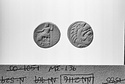
Koressia (Keos) ... BMC 66 Head of Apollo r., laur. [KO|PH] Bee ... 4th-2nd c. B.C ... [KO|PH] Bee. |
Ioulis (Keos) ... Coin no. 18. Varia. Bearded head r., laureate. [IOYλIC]
Bee. 391 ... 4th-2nd c. B.C ... Coins | By Subject | Animals | Bee |
Ephesos ... Coin no. 64. Yellow fill. Ε - Φ
Bee. Stag kneeling l., head turned back; above, astragal ... 4th-3rd c. B.C ... Ε - Φ
Bee. |
Crete ... Roman Province of Cyrenaica and Crete ... Coin no. 11. Cistern. Head of Roma r., wearing Corinthian helmet. Bee in dotted circle. 291, 737, 743 ... Ca. 67 B.C ... Bee in dotted circle. |
| Chip missing.
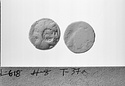
Obverse: an insect, probably a bee.
Reverse: plain. Ancient street, east end; in drain 7. Leica ... 26 April 1948 ... Obverse: an insect, probably a bee.
Reverse: plain. |
| Koressia (Keos) ... BMC 66.
[obv. cmk.: head l., in incuse circle] Head of Apollo r., laur. [KO|PH] Bee. 85-8-15 ... 4th-2nd c. B.C ... [KO|PH] Bee. |
Floor fragment. Surface slightly pitted. Max. dim. 0.042.
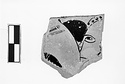
I, warrior (face protected by a low-crested Corinthian helmet) to left, holding a round shield (device: bee[?], wasp[?]). The rim of the shield ... Ca. 510-500 B.C ... I, warrior (face protected by a low-crested Corinthian helmet) to left, holding a round shield (device: bee[?], wasp[?]). ... Dilute glaze: wings(?) of bee.
For the shield device, see 829. |
Ephesos ... Heavily damaged.
Part of coin missing. Coin no. 46. Great Drain, disturbed gravel fill. Head of city goddess r., turreted. [E]-φ
Bee. 748, 1300, 1484 ... 4th - 3rd c. B.C ... [E]-φ
Bee. |
| Sardis ... Philip III, Kings of Macedonia ... Head of young Herakles r. φIλIππOY behind Zeus seated l., holding eagle and scepter; at l., bee or rosebud; below, ΤΙ. 85-5-28 ... Ca. 323-319 B.C ... φIλIππOY behind Zeus seated l., holding eagle and scepter; at l., bee or rosebud; below, ΤΙ. |
Lozenge-shaped stamp. Hellenistic fill beside wall, below "intermediate" strosis. Ἐ̣πὶ Ἀπ̣[ολ]λωνίδ | α
Κνι bee δι(
Ἀπολ̣λ̣ω̣ν̣ίου
(Α broken-barred, in diamond) Leica ... 17 May 1954 ... Ἐ̣πὶ Ἀπ̣[ολ]λωνίδ | α
Κνι bee δι(
Ἀπολ̣λ̣ω̣ν̣ίου
(Α broken-barred, in diamond) |
Probably typical; broken at curve.
Typical clay; fired yellow at surface; traces of light slip.
Diamond-shaped impression; sharp. Ἀπολλων | ίου (ΙΟΥ retr)
bee
Κνιδι(
(in diamond) Leica ... 15 March 1932 ... Ἀπολλων | ίου (ΙΟΥ retr)
bee
Κνιδι(
(in diamond) |
Methymna (Lesbos) ... BMC 19--23; P. R. Franke, in H.-G. Buchholz, Methymna, Mainz 1975, p. 170, no. 22.
[(M 18:10)] Head of Athena r., wearing Corinthian helmet. Cmk.: bee. [M]-A|[θ]-Y Kantharos ... ca. 350/330--250/240 B.C ... Head of Athena r., wearing Corinthian helmet. Cmk.: bee. |
Much worn fragment of Knidian type.
Right(?) end of losange-shaped impression preserved, much worn. Par: SS 00277* With early Byzantine and late Roman sherds. Ἀπολλων | ίου (ΙΟΥ retr)
bee
Κνιδι( ... 26 April 1933 ... Ἀπολλων | ίου (ΙΟΥ retr)
bee
Κνιδι(
(in diamond) |
| Part of the interior medallion; helmeted warrior's head left, with part of his shield held up in front; the device on the shield a bee? 6th.-5th. c. B' building fill. Leica, 88-5-8 ... 4 April 1935 ... Part of the interior medallion; helmeted warrior's head left, with part of his shield held up in front; the device on the shield a bee? |
Broad, ribbed, junction with neck not preserved except in one small place.
Coarse micaceous clay; red, yellowing to surface; light slip.
More than half of the impression broken or chipped away. Ἀθη
... 1 March 1932 ... Ἀθη
bee
ν̣[ίππου]
(Α broken-barred, in oval) |
Battered fragment of rather small handle.
Fired light clay.
Rather worn losange-shaped impression probably frpm same die as SS 277; attribute like a shoe dole. Par: same die as SS 00277* Under layer ... 19 June 1933 ... Ἀπολλων | ίου (ΙΟΥ retr)
bee
Κνιδι(
(in diamond) |
| Achilleus. Achilleus and Aias Gaming. Athena Polias. Athlete. Aias. Aineas carrying Anchises. Akademos. Akastos. Chimaera. Amazon. Bee. Bellerophon. Cock. Amazonomachy. Bird. Animal, upside down. Animal ... Agora 23 359 ... Bee |
| Wall fragment only with a little of lower part of panel preserved; mended from three pieces.
Hind legs of a horse right, and part of his tail, two very narrow black lines at the bottom of the panel. Flying ... 25 July 1950 ... Fraser (1951), Bee Keeping in Antiquity. |
Fragments of wall and most of in- turned rim missing.
Flaring ring foot. Steep lower wall, meeting upper at a sharp angle. One horizontal bee-shaped handle. Reserved: resting surface and underside with ... Ca. 500 B.C ... One horizontal bee-shaped handle. |
Most of shoulder with stub of handle and body with part of fillet between it and the foot. Strengthened with plaster. Glaze misfired in places; abraded here and there. P.H. 0.138; diam. 0.081. H. A. Thompson, ... Ca. 510 B.C ... The shield devices are a serpent, a bee, and an anchor. |
|
|

.png.icon.jpg)
