|
|
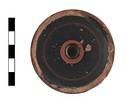
Top of knob missing.
Lid. Domed top, inset flange beneath. Top offset from flat rim. Scraped groove on outer face of rim, one at junction of rim and dome, one at base of knob ... 4th c. B.C ... Agora XII, no. 12 |
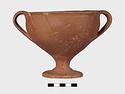
One spur and pieces of rim and upper body restored.
Reserved resting surface with no groove; conical underside.
Tapering stem. Upper body tapering. Rim not thickened. Rising spurs with nearly parallel ... 300-290 ... Agora XXIX, no. 12 |
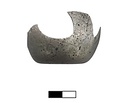
Mouth fragment with start of neck. Mouth flares slightly, flat and glazed on top. Glazed on inside. Much of the glaze fired red; abraded in places. Max. dim. 0.122.
On side of mouth, ivy wreath with berries, ... Ca. 440-430 B.C ... Agora XXX, no. 12 |
| Small base with part of stem.
Black glaze and narrow purple band.
c.f. Agora P 16463 (Agora 12, no. 1220); Agora P 2754 (Agora 12, no. 1234). First identified as base, now regarded as lid. Oscar Broneer, ... 13 April 1937 ... Black glaze and narrow purple band.
c.f. Agora P 16463 (Agora 12, no. 1220); Agora P 2754 (Agora 12, no. 1234). |
Rim and about half of wall restored.
Two grooves at bottom and top of wall, which has slightly concave-convex profile. Flaring, angular knob; top of raised edge lightly grooved; pointed center. Knob: ... 120-86 ... Agora V, p. 12, note 12 |
A few small areas restored.
Rim strongly inclined to inside. Flaring, bell-shaped body with two grooves at bottom and top. High knob, convex to outside, with groove in top of raised edge; convex center ... 50-10 ... Agora V, F 17, p. 12, pl. 63. |
Half of body and rim restored.
Angular rim inclined to inside. Very flaring body with two grooves at bottom and top. Angular knob with light groove in top of raised edge; slightly pointed center. Knob: ... 50-10 ... Agora V, F 16, p. 12, pls. 1, 63. |
Open bowl on straight-sided ring foot; two rolled horizontal handles, uptilted. Plain rim, flat on top, drawn out on one side to form a spout. Cooking ware.
For earlier examples see P 5416 F 12:5; P 22725 ... Context ca. 520-490 B.C ... For earlier examples see P 5416 F 12:5; P 22725 O 12:1 Agora, VIII, pl. 11, 212 and pl. 12, 224, the handles without uptilt; for a fragment from a later context P 21944 N 7:3 Hesperia, XXII, 1953, p. 96, 118. |
| Fragment from mouth and shoulder of a wide-mouthed pot, with a low vertical neck ending in a plain lip, and a round body. Fragment preserves one handle, a lug in shape of inverted U with two vertical piercings ... 2 June 1937 ... Agora XIII, no. 12. |
P 19055 a, b
Body (b) mended from ten fragments, lid (a) from thirteen fragments, with most of bottom of body and small parts of lid restored; burning on bottom of body.
Bottom nearly flat. Upper wall ... 325-300 |
Toe and fragments of wall missing.
Stamped decoration: ovules, meander, incised lines with arcs, meander, alternately linked palmettes with stamped curls in the linking. Worn.
Also with same stamps, ... 430-420 B.C. |
Both handles and toe missing.
Stamped decoration: ovules and meander on shoulder, meander with a row of spiral dots and alternately linked palmettes above and below on the body and a spiral dot within ... 430-420 B.C. |
Over half of rim and parts of wall and floor missing.
Rounded resting surface; pointed underside. Convex body with slight flare at top. Rim slightly undercut inside. Metallic brown glaze, mostly missing; ... 150-110 |
Chips of wall and floor missing.
Flaring foot, concave to outside; rounded resting surface; slightly convex underside. Angular wall. Dull black glaze; finger marks on foot and lower wall.
The earliest ... Ca. 260? |
Flat underside, reserved.
Very similar is P 7301 B 12:6 ... 480-450 B.C. |
| Broken in three pieces, but complete.
About 0.018 below the head, the shaft of the pin passes through a small conical lump of bronze.
Bit of bone from burial attached to pin by corrosion. Agora sample ... 8 March 1932 |
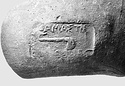
| Pinkish buff clay, red stain. Nb. No. 1. Trench A, 10-13m from N. end. Assembly Place; filling of Period III. ΘΑΣΙΟΝ ΔΑΜΑΣΤΗΣ ΚΛΕΟΦΑΝΗΣ 165 ... 29 Dec 1930 |
Parts of body restored.
Rounded resting surface; pointed underside. Deep lower body.
Two pairs of antithetical leaping dolphins spaced by white dot rosettes; wave pattern of white undulating line over ... 250-240 |
Part of foot and chips of rim missing.
Broad beveled resting surface; convex underside. Decoration as 202, mostly missing on one side. Metallic black-to-brown glaze, peeling, with stacking line; miltos ... Ca. 240 |
One-third of rim, part of wall, and almost all of underside missing.
Flat, reserved underside. Body vertically combed; grooving stops shortly before bottom of wall. Red glaze with large black patch, outside ... 310-275 |
Back part of lamp; fragmentary.
Rim, plain; discus, plain, with central filling hole and three air holes appearing.
Stubby ladle handle; broad and thin, merging with body.
On bottom, double irregular ... 15 June 1931 |
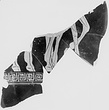
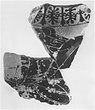
| From a closed pot; amphora? Pelike? Loutrophoros? Maeander ground line. Horses' legs and feet to right. Occasional relief contours; brown for muscles.
ADDENDA (Sept. 2020), according to Agora XXX, Pelike ... 3 April 1936 ... Agora XXX, no. 39, pl. 12. |
Jug type.
Others, P 23189 H 12:15-POU Pots and Pans, fig. 40, second from right; J.H.S., LXXXII, 1962, pl. V, 4, left; P 25774 Q 12:3 Pots and Pans, fig. 40, second from left ... Context ca. 525-500 B.C. |
| Kylix base with black glaze. Inscribed on bottom. Oscar Broneer, Nb. No. 4. Protect from abrasion. 175 88-395 ... 29 May 1937 |
Flat underside, reserved.
Similar, P 5329 E 13:1. Also a pair, P 11778-9 H 12:6 ... Ca. 425 B.C. |
Top of handle broken off. Downturned flange set in from edge of rim. Flat narrow rim and convex top set off from rim and handle by narrow reserved bands. Reserved groove around outer face of rim.
Black ... April-May 1936 ... Agora XII, no. 12, pl. 1. |
Back part of lamp only preserved.
The lamp has a set off base with raised center. The almost vertical side makes a sharp angle at the shoulder. The disc, of which only the edge is preserved, rises above ... 1935 ... Agora VII, no. 12, p. 73. |
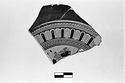
| Rim fragment. Heavy vertical rim with ivy wreath, the leaves reserved, the tendrils and berries painted in (faded) white.
Glaze mottled black to red. Well to North of Nymphaeum, Box 18. Leica ... 12 April 1954 ... Agora XXX, no. 12, pl. 6. |
One large fragment preserves part of floor and foot; two small joining fragments give a little of the rim. Flat floor; broad ring foot; incurved rim.
Firm red glaze.
On the floor, the ends of two lead ... 5 June 1952 ... Agora XXXII, no. 12, fig. 1. |
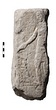
| Narrow section of center part of grave relief. Low, well-modeled relief, very worn and weathered.
Preserved are knees to feet and right hand of seated female figure on left, and head to feet and right ... 22 August 1977 ... Agora XXXV, no. 12, pl. 4. |
Center of floor missing.
Ring foot; grooved rim. Unglazed.
Also unglazed with similar profile, P 11769 H 12:6 ... 425-400 B.C. |
Part of a large open pot with broad ring foot and straight side wall, thickened and grooved at the bottom.
Attic clay; good buff slip. Black glaze inside. Pit, second half of 5th. c. Leica PD 1132-1 ... 1-2 April 1936 ... Agora X, no. DM 12. |
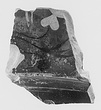
| Fragment a) from shoulder, b) from wall, both non-joining and broken all around. From a closed large vase of which the neck was painted inside. On the outside a helmeted head, to left, in black figure ... 10 May 1935 ... Agora X, no. LM 12. |
| Mended from many pieces; wall and rim fragments and one handle missing; restored in plaster. Low stem; spreading foot; underside of foot slightly concave, with a neat hemispherical depression at its center; ... 8 August 1953 ... Agora XIII, no. XXIV-12. |
| Lower part of small vase.
Centrally rising bottom, and part of walls preserved.
Slight incurve at top of fragment.
Pale greenish blue iridescent glass speckled by bubbles. A few other fragments of glass ... 5 May 1932 |
Flaring ring foot; the mouth flat on top; low strap handle. Added red: two lines at level of lower handle-attachment. Glaze peeled.
Beside 106-110 there are only three choes in the Agora which come from ... Ca. 500 B.C ... Beside 106-110 there are only three choes in the Agora which come from pre-480 B.C. deposits: P 12543 G 11:3- POU, P 24122 Q 12:3, and P 24662 R 12:4-POU. |
Similar, the foot somewhat higher, P 24667 R 12:4-POU Hesperia, XXV, 1956, pl. 22b. The typical late archaic shape ... Context ca. 525-500 B.C. |
Mask and base of handle.
High crown with hair coming down to central point. Large trumpet.
White fillet hangs from crown of head. Hair and trumpet painted.
Shiny black glaze ... 235-175 |
Vertical handle and one horizontal handle missing.
Flaring rim, false ring foot.
The flaring rim, heavy body proportions and rudimentary foot are early features, but this piece does not correspond closely ... Context probably as late as the mid 6th c. B.C ... The flaring rim, heavy body proportions and rudimentary foot are early features, but this piece does not correspond closely to any in the Agora series; already by the later 7th century, cooking-ware hydriai are better made and more developed, closer to 1590; cf. P 23461 R 8:2 Agora, VIII, pl. 12, 219. |
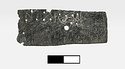
| Thin oblong plaque, inscribed.
The left end of the plaque is broken off. At the right end is the partially obliterated outline of a stamped Gorgoneion. On the reverse are traces of a rectangular stamp ... 20 July 1931 |
Broken off below knee and at shin.
Quite well-modeled piece with very well developed musculature. Good finish. Under life-size.
White Marble. Clearing Coarse of Water Channel on Northeast Shoulder of ... 1931 |
Intact except for a chip or two and slight abrasion of the glaze. Glazed on underside. Diam. 0.07; H. 0.01. Agora XXVII, p. 168, cat. no. 12, pl. 31.
On top side: wheel with starburst pattern in center ... Probably late 5th century B.C ... Diam. 0.07; H. 0.01. Agora XXVII, p. 168, cat. no. 12, pl. 31.
|
| Fragment from the interior medallion. The border consists of alternating tongues of black and red bound on both sides by concentric circles and alternating dot bands. Within is the head and left shoulder ... 16 June 1931 |
| Complete save for a chip from the bottom
The back is roughly modelled; the bottom open.
A youthful female figure stands erect, the right knee out-thrust and slightly flexed. She is clad in a long himation ... 1931 |
Black figured fragment. A warrior wearing greaves and carrying a spear walks to right. Behind him a panel of palmette and lotus. In the zone below is out spread wing, and behind it a panel with some design ... 25 Apr 1931 |
Stamp on top: chi.
Glaze: red except on bottom.
Clay: reddish, little mica Assembly Place, filling of Period III ... 1931 |
Right side broken away.
Almost straight sides; flat horizontal band-handle. Deep groove around rim. Lettering scratched on the nozzle.
Clay: fine buff, black glaze (much worn) inside and out. Assembly ... 1931 |
Bottom preserved, broken at top, sides and back.
Well-cut letters.
Pentelic marble. Wall Trench. [---]ν απ[---]
[---σφε]τέρα[ν] ... 18 June 1936 |
A plain bar of bronze, forked at one end, at the other hammered into the shape of a wedge in the same place as the fork. Possibly to be set into wooden handle. Does not look like netting needle - prongs ... 3 January 1931 |
I. Cloaked youth, left. A round object (sponge or aryballos) hangs from his extended right hand. Part of reserved band around tondo preserved.
No relief contour. The glaze worn from use. Stump of stem ... 1931 |
Half of wall and rim missing.
Flaring foot; flat, narrow resting surface; pointed underside.
Strongly flaring rim. Rouletting on floor. Very micaceous, reddish yellow fabric (5YR 6/6); shiny red glaze ... 150-125 ... Agora V, p. 14, under F 34 ... Thompson 1934, D 12, p. 371 |
| Restored in plaster. Ring foot and high rounded body forming a continuous double curve with the narrow neck and flaring round mouth. One vertical handle.
Pink clay (2.5YR 5/6) with creamy slip (10YR ... March-April 1936 ... Agora XXXIII, no. 73, fig. 12, pl. 12. |
| Fragments missing from body; restored in plaster. Ovoid body on a broad low ring foot. Very short neck, curving out at the top to form a round mouth with plain flaring lip. Small vertical band handle from ... 28 April-2 May 1939 ... Agora XXXIII, no. 71, fig. 12, pl. 12. |
| Several small holes in body; minor chips; otherwise unbroken. Small trefoil mouth with deep collar and rounded rim. Very narrow neck; plump body; ring foot. Roughly ribbed handle, from below collar.
... 28 April 1948 ... Agora XXXIII, no. 75, fig. 12, pl. 12. |
Pieces of rim and wall missing.
Rounded resting surface; convex underside. Dull red glaze, black below rim outside.
Similar: P 4704 (G 12:6) ... 275-250 |
| One-third preserved mended from many pieces; one fragment does not join. Flat bottom, flaring sides and inward-sloping rim, undercut outside to form a keel. Two sets of concentric grooves on floor.
Very ... 9 May 1951 ... Agora XXXII, no. 364, fig. 12. |
Torus ring foot; broad handle, glazed outside. Rim slopes outwards, glazed. Inside, reserved central disc with two glazed circles and dot; outside, glazed band, inner face of foot, underside with two circles ... Ca. 500 B.C. |
Rim and wall fragment. P.H. 0.052; est. diam. at rim 0.10.
Owl (feet missing). To left and right, part of an olive sprig. Dilute glaze: dots on face.
Johnson (AJA 59, 1955 [ pp. 119--124], p. 121) suggests ... Third quarter of the 5th century B.C. |
Bottom missing, sides and exterior chipped.
Mold for large handle with spur with parallel sides. Micaceous, reddish yellow fabric (5YR 6/6).
Shape of spur close to 6 and P 3778 (Agora XII, no. 704, p ... 325-300 ... Shape of spur close to 6 and P 3778 (Agora XII, no. 704, p. 286, pl. 29 [F 12:3, lower fill]). |
One handle, most of upper body, and part of lower body restored.
Glazed groove in resting surface, the inner edge of which is scraped; concave underside with nipple. Low, concave stem. Slightly rising, ... 325-300 ... Agora XII, no. 714, p. 287, pl. 29 ... Rotroff 1984b, no. 12, p. 353, pl. 67:f. |
Tops of handles restored.
Broad resting surface with scraped groove; concave underside with nipple. Thin stem. Slightly elongated body. Gray fabric; shiny black glaze with brown stacking circle on floor ... Ca. 300 |
Small chips missing.
Broad, beveled resting surface; pointed underside. One pair of antithetical leaping dolphins, with white dot rosettes between them and flanking them; spiral wave pattern running right, ... 250-240 |
One handle and parts of wall and foot restored.
Broad, beveled resting surface; slightly nippled underside. Two pairs of antithetical leaping dolphins spaced by white dot rosettes; spiral wave pattern ... 250-240 |
Thickened rim, globular body, straight-sided ring foot. For the handle set still lower see P 24663 R 12:4-POU Pots and Pans, fig. 28 left ... Context ca. 520-480 B.C. |
Mended with missing pieces restored in plaster and painted. Two concentric circles with central dot on underside of floor. H. 0.082; diam. at rim 0.178; width with handles 0.252; diam. of tondo 0.078; ... Ca. 510 B.C ... Thompson, Hesperia 24, 1955, pp. 64--65, fig. 3, pl. 28:d; Ginouvès, Balaneutikè , p. 63, pl. 12:36; D. B. Thompson, An Ancient Shopping Center (Agora Picture Book 12), Princeton 1971, fig. 23; M. Lang, Graffiti in the Athenian Agora (Agora Picture Book 14), Princeton 1974, fig. 36; R. |
Small chip missing from rim.
Flattened base, irregular underneath. Plump body. Shiny red glaze inside and out.
Cf. P 1453 (H--K 12--14), nearly a twin ... 250-175 |
Flat bottom, left rough; thickened lip. Angular profile; wide neck; a groove at the top of the shoulder. Light red clay with large white particles; dull red to black glaze, much worn and peeled. Extremely ... Context ca. 580-560 B.C ... Somewhat similar, but the profile less angular, P 4793 F 12:5 Agora, VIII, pl. 13, 237, possibly from Egypt. |
Rim chipped.
Flat underside with string marks. Thick wall, concave profile.
Micaceous, reddish yellow fabric (7.5YR 7/6) of medium hardness.
Similar: P 1529 (H--K 12--14) ... 200-175? |
About one-fourth of rim and one handle.
Very low everted rim. Shiny black glaze.
Similar rim: P 21025 (H--K 12--14), with two grooves on body ... 200-175 |
| Mouse outstretched on an oval plaque.
The plaque is broken at the back and has two small holes at the front.
Inscribed beneath the lettter A.
Crude technique; no details. Unglazed.
Buff clay.
205 Leica, ... 24 June 1931 |
High ring foot; angled wall, flaring above; rim projecting outwards. Decoration inside: central circle, eight palmettes roughly linked within sketchy rouletting. Glazed inside and out. Reserved: the resting ... Ca. 325 B.C. |
Intact.
Slightly concave underside with string marks. Wall slightly concave at base, convex above. Reddish yellow fabric (5YR6/6); very thin, dull orange wash.
Others of Hellenistic date with thin wash: ... 325-275 |
Rim and most of wall missing.
Blunt spade-shaped projecting nozzle.
Traces of reddish glaze inside.
Soft pinkish clay.
Type 3 of Agora collection. Well. Leica, XLIX-52, 8-249 PD 635-9 ... 2-7 April 1938 ... Agora IV, no. 24, p. 12, pls. 1, 29. |
Ring foot with grooved resting surface. Reserved: resting surface and junction of foot and wall. Glaze flaked.
Similar, P 13242 G 12:20 and P 13546 O 18:2 ... 350-325 B.C. |
Wall fragment with start of base. P.H. 0.03; max. dim. 0.096; Agora XXI, p. 33, F 46, pl. 12.
A bit of the figured decoration remains, but it is difficult to know what it is, perhaps a large stone(?) ... Ca. 500 B.C ... P.H. 0.03; max. dim. 0.096; Agora XXI, p. 33, F 46, pl. 12.
|
Two scraped grooves at base of stem. Fillet at junction of foot and wall. Reserved: outer face of foot, resting surface and center of stem inside with circle and dot, handle-panels. Glaze peeled in parts ... 500-480 B.C. |
Intact.
Slightly concave underside with string marks. Steep, convex wall.
Pink fabric (7.5YR 7/4); thin, dull black glaze.
Other fairly well glazed saucers of Hellenistic date: P 19872--P 19875 (Young ... 350-300 |
Globular body with well-rounded shoulder; high flaring ring foot; handle set on shoulder.
On some examples of the last quarter of the 6th century the shape is more ovoid; cf. the large inscribed hydria ... Context ca. 520-490 B.C. |
Fragment of top side. Much of the glaze misfired reddish and greenish. Max. dim. 0.074. Hoffmann, Sexual and Asexual Pursuit, p. 12, cat. no. Ja 1.
Symposion. A, a man (arms, part of torso and legs), ... Ca. 450 B.C. |
Unglazed.
Cf. P 2880 G 13:4 Hesperia, III, 1934, p. 326, fig. 9, A 66 and P 13243 G 12:20 Suppl. IV, 1940, pp. 134-135, fig. 99 c ... End of 4th c. B.C. |
About half preserved; profile not complete.
Ring foot; grooved rim. Raised ring on underside. Groove on undersurface. Unglazed.
Also unglazed with similar profile, but lower, P 2835 H 12:11-U ... Ca. 375 B.C. |
Lid missing.
Low ring foot. Deep wall, inset. Reserved: resting surface and underside with glazed circle and central dot.
Similar and with lid missing, Cambridge GR. 12. 1854, not certainly Attic ... 425-400 B.C. |
Torus ring foot; horseshoe handle, glazed outside. Wall has slight double curve; rim rounded on top, glazed. Inside, reserved central disc with two glazed circles and dot; outside, glazed band, inner face ... Ca. 480 B.C ... Others similar: P 8820 E 14:5; P 20775-6 R 12:1; P 24619-20 Q 12:3. Other published banded one-handlers from the Agora belonging to the archaic period are P 1294 G 6:3-U Hesperia, XV, 1946, pl. 66, 293 and P 1385 ibid., pl. 64, 252. |
Fragment of neck and shoulder. Groove on neck above swastika. P.H. 0.027; max. dim. 0.067. Agora XXI, p. 95, M 12, pl. 60.
At the far right, a little bit of the shoulder, right forearm, and right hand ... Probably late 5th century B.C ... P.H. 0.027; max. dim. 0.067. Agora XXI, p. 95, M 12, pl. 60.
|
Many fragments of body missing.
Resting surface outwardly beveled; resting surface and underside reserved. Top of handle, where it over hangs mouth, very pointed. Dull black glaze.
Similar: P 8302 (C ... 325-300 |
Bevelled ring foot; bell handle, glazed outside. Rim flat on top, reserved. Inside, reserved central disc with two glazed circles and dot; outside, glazed band and line, outer and inner faces of foot, ... 520-500 B.C. |
Part of foot, floor and wall.
Flaring ring foot; lower part of wall slightly concave, a groove at the junction with the upper wall. Reserved: under- side with glazed circle, band, two circles and dot ... Ca. 420 B.C. |
Rectangular; no handles.
Similar, with one handle, P 8305 C 12:2 Hesperia, XXVII, 1958, pl. 49 d and p. 232; also, from Olympia, Olympia-Bericht, IV, pp. 103-104, figs. 87-88 ... Context not later than 4th c. B.C. |
Handle and much of wall missing; profile not complete.
Ring foot; ribbed body. Around the neck, olive wreath in added clay with traces of gilding.
Besides the pieces catalogued that have added clay and ... 325-310 B.C. |
Two-thirds of rim and wall missing.
Flat resting surface; small, pointed underside. Angular profile.
Dull to metallic brown glaze, stacking circle.
Similar: P 21005 (from same context), P 19753 (P--R ... 225-175 |
Wall fragment. Max. dim. 0.026.
Woman (head with sakkos, shoulders) standing frontally, looking to left. She seems to wear a chiton decorated with dots. Relief contour.
Manner of the Icarus Painter (ARV2 ... Ca. 470 B.C. |
Rim fragment. Max. dim. 0.063; est. diam. at rim 0.14.
On rim, myrtle wreath to right with berries. White (flaked): vine; berries; line below wreath.
For the myrtle wreath, see Adolphseck 72, near the ... Ca. 450 B.C. |
Fragment from the back, with heavy vertical loop handle.
Flat bottom; rising rim.
Coarse brown micaceous clay, much blackened.
Type 2B of Agora collection.
Early Attic. Pit in northeast corner of Metroom ... 24 May 1938 ... Agora IV, no. 12, p. 10. |
Tiny chips of rim missing.
Flat resting surface; pointed underside. Convex wall with angle at top. Downturned rim. Thin, dull black-to-orange glaze on floor only.
Similar: P 20906 (Agora XXVII, no. 208, ... 200-175 ... Similar: P 20906 (Agora XXVII, no. 208, p. 194, ill. 41, pl. 49 [Q 8--9]), P 22860 (H--K 12--14). |
| Mended from two pieces. Heads and necks of two horses and mane, part of neck and back of a third horse from a chariot team to right. Decorated yoke and collars of horses. Palmette and lotus band above ... 30 April 1953 ... Agora XXIII, no. 97, pl. 12. |
Three fragments, non-joining; one from rim. Mold for bowl with irregular reticulated projections, like a pine cone.
Signature incised on bottom before firing on fragment b).
Heavy fabric; roughly made ... 7-12 May 1949 ... Agora XXII, no. 12, pp. 5, 16, 41. |
| Broken above, below and on both sides.
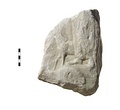
Lower part of draped figure (male?) and animal (deer?) standing on uneven ground.
Pentelic marble. Marble pile S.W. of Temple of Ares. Leica ... 5 July 1951 ... Agora XXXVIII, no. 12, p. 31, pl. 3. |
| Inscribed fragment.
Part of smooth top and smooth back preserved; otherwise broken.
Three lines of the inscription preserved.
Hymettian marble. Finished Found in late context, north of the Tholos. Leica ... 9 March 1934 ... Agora XVIII, no. C162, pl. 12. |
| Inscribed fragment.
Inscribed face and a little of bottom surface, dressed with a relieving band, preserved.
Two lines of the inscription preserved.
Space between lines: ca. 0.015m.
Pentelic marble. Found ... 24 May 1951 ... Agora XVIII, no. C164, pl. 12. |
| Inscribed fragment.
Small area of top preserved; it is rough picked.
Broken right, left, bottom and back.
Part of six lines of the inscription preserved.
Pentelic marble. Found in marble pile, in the southeastern ... 19 February 1955 ... Agora XVIII, no. C160, pl. 12. |
|
|