|
|
Foot missing.
Offset neck and echinoid mouth; raised ridge at junction of neck and wall; round handles. Neck reserved. Added red: band at level of lower attachment of handles.
For a later version, see ... 575-550 B.C ... Agora XII, no. 1 |
Part of handle and half of wall and foot restored.
Reserved, grooved resting surface; concave underside. No stem.
Handles have horizontal, tapering spurs. Lustrous black-to-red glaze, stacking line ... Ca. 325 ... Agora XXIX, no. 1 |
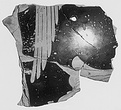
Thirteen non-joining wall fragments with thin reddish wash on inside. Mended in antiquity (part of lead repair in b; hole in d). Glaze pitted and abraded here and there. P.H. a) 0.14; max. dim. a) 0.281, ... Ca. 440 B.C ... Agora XXX, no. 1 |
Barbotine Cup Or Jug.
Lower body and most of wall and rim restored.
Ovoid body, upper two-thirds decorated with five rows of barbotine bosses. Body angles in to rim at top. Low rim, convex to outside ... Context of 110 to early 1st century after Christ ... Agora V, F 25, p. 13, pl. 1. |
Lagynos.
Underside, parts of body, and most of handle restored.
Flaring ring foot; flat resting surface. Flattened globular body.
Fairly long, tubular neck. Flaring rim, flat on top and undercut on ... Second half of 1st century (context of 110 to early 1st century after Christ) ... Agora V, F 45, p. 15, pl. 1. |
Half of body and rim restored.
Angular rim inclined to inside. Very flaring body with two grooves at bottom and top. Angular knob with light groove in top of raised edge; slightly pointed center. Knob: ... 50-10 ... Agora V, F 16, p. 12, pls. 1, 63. |
Bottom, handle, and two-thirds of body and rim restored.
Two grooves on exterior of rim. Light red fabric (2.5YR 6/6) with mica, small grits, and voids; gritty, shiny red glaze (2.5YR 4.8), with lower ... 100-25 ... Similar: P 22097 (Agora V, G 88, p. 30, pl. 5 [D 4:1, Layer II]).
... Δελτ 21, 1966, B1 1 [1968], p. 80, pl. 84:α, from late Hellenistic to early Roman potters' debris on Otho Street in Athens. |
Rim chipped.
Convex underside. Slightly concave wall. Slight groove at either edge of rim. Shiny black glaze.
Cf. Δελτ 29, 1973--1974, B1 1 [1979], p. 43, pl. 51:δ ... 325-295 |
Pieces of body, handle, and parts of both mouths missing; no wear on resting surface.
Flaring foot; beveled resting surface; convex underside. Steeply sloping lower body curves in to meet tall upper body, ... 200-150 |
Wall fragment of stand with projecting moulding at top. Glaze scratched and abraded. P.H. 0.092. Agora XXI, pl. 30: G 8.
Woman (head with sakkos) to right. Above, egg pattern. On top of rim, tongues(?) ... Early 4th century B.C. |
Four non-joining fragments: a shoulder and wall fragment of lebes with start of handle; b + c, and e of stand, d of foot. Stand strengthened with plaster and painted. Glaze fired brownish on lebes; flaked ... Ca. 410 B.C. |
Wall fragment of stand. Glaze pitted and flaked in places. P.H. a) 0.175, b) 0.086. E. Papoutsaki-Serbeti, Ὀ Ζωγράφος τῆς Providence, Athens 1983, pl. 33; K. Arafat, Classical Zeus, Oxford 1990, pl. 31 ... Ca. 470 B.C. |
Wall fragment of stand. Max. dim. 0.086.
All that remains of the figures is part of their drapery.
Not from the same stand as 120 because the wall is too thin and the size seems slightly smaller ... Ca. 470 B.C. |
Stand. Base, upper part lost. Much of the glaze flaked and abraded above wool basket. Surface pitted. P.H. 0.16; diam. at top 0.13. P. E. Corbett, Hesperia 18, 1949, p. 313, cat. no. 8.
Parts of two pairs ... Ca. 410 B.C. |
Wall fragment of stand. Glaze pitted in places. P.H. 0.103; max. dim. 0.143.
Man (head, right hand, and foot missing) standing to right, wrapped in a himation. Behind him, the lower drapery of another ... Ca. 410 B.C. |
Wall fragment of stand. Glaze fired brownish. P.H. 0.067; max. dim. 0.08.
Woman (torso, right arm) standing to right, wearing a peplos and holding a box on her left forearm. Preliminary sketch.
Probably ... Ca. 410 B.C. |
Wall fragment of stand with bands of glaze on inside. Max. dim. 0.06.
Kithara-player. All that remains is part of his instrument: the tip of one arm, a bit of the support; half of the crosspiece with ... Ca. 480-470 B.C. |
Stand mended from many fragments, with the missing pieces restored in plaster and painted. Bottom of lebes preserved. Glaze pitted in places. P.H. 0.232; diam. of base 0.162.
Two pairs of women facing, ... Ca. 430-420 B.C. |
Wall fragment of stand from near top with start of projecting rim.
Black bands on inside. Glaze abraded in places. P.H. 0.085.
Upper parts of two Doric columns, one column slightly behind the other ... Ca. 440-430 B.C. |
Wall fragment of stand. P.H. 0.151.
Parts of four women: back of head, drapery of 1 to left; head, shoulders of 2 wrapped in a himation to right; 3 (legs missing), also to right, nude but for a girdle ... First half of the 4th century B.C. |
Fragment of miniature stand. Glaze fired brownish in places. P.H. 0.063.
Woman to right, carrying a box with a sash. Then comes another woman (illustrated) to right, looking back and wearing a short chiton ... First half of the 4th century B.C. |
Fragment of slightly domed lid, from near center. Max. dim. 0.09.
Top side, from center out: ends of rays; black band; egg pattern with dots; black band. At the right break on a black band there is a ... Probably second quarter of the 5th century B.C. |
Wall fragment of stand. Max. dim. 0.10.
Woman (most of body) wearing a peplos, standing frontally. At the right, part of her left arm, the elbow bent with the forearm projecting. At the upper left, the ... Ca. 410 B.C. |
Wall fragment of stand from near top. Groove below pattern. P.H. 0.095; P.W. 0.09.
Two women (face of left, head and shoulders of right wearing a himation) facing. Between them is a round shield (starburst ... Second quarter of the 5th century B.C. |
Wall fragment of stand with part of black band on inside. Glaze flaked here and there. Max. dim. 0.082. LIMC II, 1984, p. 200, no. 85, s.v. Apollon.
Apollo. The fragment preserves the chin, neck, long ... Ca. 460-450 B.C. |
Shoulder fragment of lebes with start of neck. Max. dim. 0.055.
Two women (face, shoulder of one; back of hair of other) both to right. Around each head is a fillet. Above, tongue pattern. White: fillets ... Ca. 460-450 B.C. |
Wall fragment of stand from near top. Max. dim. 0.047.
Warrior (most of helmeted head) looking to left. Wreath around helmet. At the bottom, a little of the rim of his shield decorated with chevrons ... Ca. 440 B.C. |
Three non-joining wall fragments of stand, a with bottom of lebes. Stand pierced (hole in a and c). Torus between lebes and stand. Much of the glaze fired brownish; flaked in many places; abraded on torus ... Ca. 440-430 B.C. |
Lid fragment of brim with flange on underside. Max. dim. 0.093; P.H. 0.034; est. diam. 0.24.
On interior of top side: diagonally addorsed encircled palmettes (most of one) and tendrils. At outer edge ... Ca. 430 B.C. |
Fragment of upper part of stand with projection at top. Glaze abraded a little on projection. P.H. 0.074.
Woman (back of filleted head, start of shoulder) to left. Behind her, the capital and shaft of ... Ca. 430-420 B.C. |
Wall and torus base fragment of stand. Glaze chipped here and there. P.H. 0.10; P.W. 0.172; est. diam. of base 0.29.
Two women (lower drapery of each) one to right, the other frontal, each wearing a long ... Ca. 410 B.C. |
Three non-joining wall fragments of stand, a from near top, b and c preserving part of the torus foot. Much of the surface pitted on a; glaze abraded on foot. P.H. a) 0.11, b) 0.073, c) 0.05.
Fragment ... Ca. 410 B.C. |
Wall fragment of stand. Glaze fired greenish in places. Max. dim. 0.053.
Woman (head with sakkos, start of shoulders) to right, head bent downward somewhat. Preliminary sketch. Relief contour ... Ca. 410 B.C. |
Wall fragment from top of stand with molding and bottom of lebes.
Glaze abraded along edge of rim. P.H. 0.09.
Woman (most of head with sakkos) to right. Behind her, traces of an object, perhaps a chest ... Ca. 410-400 B.C. |
Wall fragment of stand. Glaze fired somewhat greenish. P.H. 0.068; P.W. 0.054.
Woman (most of head, body to hips, part of each arm) standing frontally, looking to left. She wears a peplos. At the right, ... Ca. 410-400 B.C. |
Two non-joining wall fragments of stand. Glaze flaked in places. Max. dim. a) 0.07, b) 0.068.
Fragment a shows most of the head and part of the left shoulder of a woman to left. Around her head is an ... Late 5th or early 4th century B.C. |
Wall fragment of stand. P.H. 0.07; P.W. 0.10.
Woman (torso with chiton and much of left arm and hand; bracelet on wrist) to left. Cross-girdle on upper body. At the far left, a bit of reserve that may ... Late 5th or early 4th century B.C. |
Wall fragment of stand with streaky black glaze on inside. At the very top on the inside there is a slight incurving to indicate the bottom of the lebes. H. 0.044; W. 0.05.
Nike(?) or Eros(?) (head with ... Late 5th or early 4th century B.C. |
Six non-joining fragments, a with turn of shoulder and only the start of the handle at the upper right, e of neck and shoulder with ring at junction, and f of base. Max. dim. a) 0.108, b) 0.05, c) 0.031, ... Probably early 4th century B.C. |
About half of lower part of lebes, all of stand. Molding between lebes and stand. Glaze misfired red. P.H. 0.104; diam. of foot 0.058.
On lebes, from left to right: back legs of klismos(?), wool basket ... First half of the 4th century B.C. |
Wall fragment of stand. Max. dim. 0.058.
Part of figure (legs) to left. In the upper right, a bit of reserve.
White: legs. Dilute (faint): muscles ... Probably second quarter of the 4th century B.C. |
Composed of two pieces from different though con- temporary deposits, the length measured from P 26177, a complete handle.
Double rolled handle with loop at end. The bowl dipped, the handle unglazed ... 425-400 B.C. |
Flat bottom rising to central tube. Reserved bottom. Glaze worn and peeled for the most part.
A little earlier, P 2350 R 13:4 Hesperia, IV, 1935, p. 510, 63 ... Ca. 425 B.C. |
Tip of one handle, half of foot, and part of upper and lower wall restored.
Flat resting surface; conical underside; no groove between moldings of heavy foot. Low stem. Horizontal spurs with parallel ... 325-300 |
Tritoness And Eros.
Bottom, with part of lower wall.
Cup rests on broad ridge with slightly concave surface; pointed underside. Six grooves preserved on exterior. Emblem surrounded by two scraped grooves ... Ca. 200 |
Jug type.
Others, P 23189 H 12:15-POU Pots and Pans, fig. 40, second from right; J.H.S., LXXXII, 1962, pl. V, 4, left; P 25774 Q 12:3 Pots and Pans, fig. 40, second from left ... Context ca. 525-500 B.C. |
Center of floor, one-third of foot, and two-thirds of wall and rim restored.
Flaring foot; flat resting surface. Shiny, gritty black glaze; finger marks on foot and lower wall.
Similar: P 19708 (P 10:2) ... 250-200 |
Flat bottom with groove near edge; low strap handle. Reserved beneath: groove and within, with circle and dot ... Late 6th c. B.C. |
| Thirteen non-joining fragments of a red-figured amphora with a panel on each side; once mended in antiquity.
a) Preserves the lower right corner of the panel on face A and the lower left corner of the ... 4 April 1947 ... Agora XXX, no. 1, pl. 1. |
| Rim fragment of a large shallow plate, mended from two pieces. Probably with ring foot and with shallow upturned rim, a characteristic Pergamene profile.
Yellow Pergamene-like clay. Black glaze, somewhat ... 11 May 1934 ... Agora XXXII, no. 1, fig. 1. |
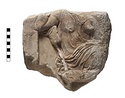
| Broken above, below and at right.
A woman seated in a chair, facing right, head and legs missing. Her right arm is raised and rests on the back of the chair. A pilaster frames the relief at the left.
Pentelic ... Late 5th c. B.C ... Agora XXXV, no. 1, pl. 1. |
Intact.
Scraped groove between moldings of foot; reserved resting surface; pointed underside. Ivy-leaf thumb rests. Ivy garland running right. Leaves on incised stems alternate with dot rosettes.
Dull ... 275-250 ... Ivy with incised stems occurs also on 480, 824, P 17864 (Agora XXII, no. 406, p. 92, pl. 69 [M 21:1]), P 20364, P 26257 (M 18:10). |
Much of handle missing and restored.
Flaring ring foot. Tall neck with ridge between lip and neck and neck and body. Below neck, a row of pendant tongues, alternately added red and black; at the niches ... 525-500 B.C. |
High flaring ring foot. Body offset from neck by a slight ridge; high round handle. A light ridge offsets neck from lip. Glaze dull grayish black.
Very close, perhaps the same potter, P 14698 S 21:2 ... Ca. 575 B.C. |
Flaring ring foot. High round handle with shallow central rib in its upper part ... Ca. 550 B.C. |
High flaring ring foot; low round handle. Large. Non- Attic, probably Lakonian. See 98, 99 ... Ca. 500 B.C. |
Disc foot, flat beneath; low round handle. Dull black glaze on outside to near the foot. Dipped. Non-Attic, probably Lakonian.
From the same deposit, 1712, also probably Lakonian ... Ca. 500 B.C. |
Handle missing.
Flat bottom; low strap handle. Non-Attic, probably Lakonian ... 500-480 B.C. |
Ring foot with concave moulding on inner face; narrowly spaced ribbing with two grooves round lowest part of wall. Double handle with shouldering. Reserved: resting surface and underside with circle and ... Ca. 450-425 B.C. |
Ring foot with concave moulding on inner face. Groove round lowest part of wall. Double handle with shouldering. Reserved: resting surface and underside with circle and dot ... 450-425 B.C. |
Handle and most of rim missing.
Ring foot. The ribs are scored with a thick implement and consist of, below, an ill-formed zigzag pattern with arcs above, then enclosed ovules and above these a narrower ... 450-425 B.C. |
Three non-joining wall fragments from each side, with start of rim. Fragment c preserves a lug. Glaze cracked here and there. Max. dim. a) 0.099, b) 0.177; diam. of rim, fragment c: 0.30. C. Boulter, Hesperia ... Mid-5th century B.C. |
Wall fragment. Max. dim. 0.12. Schwarz, Triptolemos, p. 37, cat. no. V 49, pl. 8:14; Hayashi, Triptolemosbildes, p. 136, cat. no. 37, pl. 5:1 (wrongly called a calyx-krater); Langridge, "Eucharides Painter," ... Ca. 490-480 B.C. |
Three non-joining wall fragments. Glaze fired greenish on fragment d. Max. dim. a) 0.087, c) 0.03, d) 0.122. E. Vanderpool, Hesperia 15, 1946, pl. 37:53.
Satyr to right, playing the aulos. Fragment a ... Early 5th century B.C. |
Wall fragment. Max. dim. 0.053.
Man, youth, or satyr (right foot) to right. Below, stopped-maeander pattern with cross-squares, a small dotted square in each of the reserved squares. Preliminary sketch ... Early 5th century B.C. |
Torus ring foot, lipped; high flaring stem with a moulded ring at its top. Vertical strap handles rising above the rim. Reserved: resting surface. Inscribed on the outer face of the handle: ΕΡΟΝΑΣΟΣ ΗΕΠΜΕΙ ... Early 5th c. B.C. |
| Preserved up to lower part of bowl; base chipped. Low stem; hemispherical depression in underside of foot.
Buff clay. Covered with thin red wash.
ADDENDA Agora sample no. 342. Stone packing of grave ... 22 March 1954 ... Agora ... Study Collections-Case No. 101-1/1 |
Intact.
Scraped groove in resting surface; concave underside with nipple.
Low, concave stem. Ribbed body. Rising, very slightly flaring spurs with very square ends. Slightly lustrous, mottled black-to-red ... 325-300 |
All of one handle and top of the other missing; rim chipped.
Reserved stripe on flat resting surface and at junction of moldings; concave underside. No stem. Lustrous black glaze with some metallic patches ... 325-315 |
Handle and much of wall missing; profile not complete.
Ring foot; ribbed body. Around the neck, olive wreath in added clay with traces of gilding.
Besides the pieces catalogued that have added clay and ... 325-310 B.C. |
Two-thirds of upper wall, half of lower wall, and handles missing.
Nonjoining fragment (not illustrated) preserves part of decoration.
Scraped groove between moldings of foot; broad, beveled resting ... 275-250 |
One-fourth of rim, half of one handle, and parts of body restored.
Flaring foot, slightly angular but not molded; sharply beveled resting surface; nippled underside. Upper wall nearly straight, inclined ... 275-250 |
One handle and parts of upper body restored; lower body missing.
Partially scraped groove at greatest diameter. Upper wall straight, inclined. Ivy-leaf thumb rest. Grapevine running right with single ... 275-250 |
Part of rim, half of upper body, one handle, and part of lower body preserved.
Offset at base of body. Ivy-leaf thumb rest. Dull black glaze, orange at rim ... 285-275 |
Small part of upper wall restored.
Poorly defined, molded foot; broad, beveled resting surface; concave underside. Groove under glaze below greatest diameter of body. Rim slightly inturned. Ivy-leaf thumb ... Ca. 250 |
Half of upper body and one-fourth of lower body restored.
Scraped groove between moldings of foot; slightly beveled, concave resting surface; pointed underside. Deep lower body.
Ivy-leaf thumb rests ... 275-250 |
One handle, one-fourth of upper wall, and over half of rim restored.
Scraped groove between moldings of foot; grooved, reserved resting surface; pointed underside. Ivy-leaf thumb rest. Decoration as 190 ... 275-250 |
Half of lower body and parts of upper body restored; foot missing.
Ivy-leaf thumb rests. A: spearhead necklace with thick band, dots across top, and single ties at ends; inscription φιλία[ς⟧ above. B: ... 275-250 |
Mended from many small fragments; center of floor and parts of body, rim, and foot restored.
Scraped groove between moldings of foot; flat, partly reserved resting surface. Subangular profile. Ivy-leaf ... 285-275 |
Fragment of upper wall and upper part of handle.
Mask thumb rest, made in worn mold: possibly young-man mask (cf. Webster 1978, Type O, p. 19). Dull black glaze, peeling ... 285-275 |
Single fragment of wall with lower handle attachment.
Subangular wall. Painted vertical ribbon or tie at left of handle attachment. Shiny black glaze outside, inside unglazed; miltos in scraped groove ... 275-260 |
Parts of wall restored; two lead clamps from ancient repair, one in upper body, one in lower body.
Crisp foot with scraped groove in resting surface and between moldings; pointed underside. Offset at ... 275-250 |
One handle, half of upper wall, and parts of lower wall restored; poor mend exaggerates asymmetry.
Scraped groove in resting surface and between moldings of foot; underside nippled. Upper wall nearly ... 275-250 |
One handle, half of lower body, and parts of rim and upper body restored.
Scraped groove between moldings of foot; flat resting surface; pointed underside. Offset at base of body. Ivy-leaf thumb rest ... 275-250 |
Parts of wall and part of one handle restored.
Scraped groove between moldings of foot; grooved resting surface; pointed underside. Offset at base of body. Ivy-leaf thumb rest.
Cornucopia flanked by ... 275-250 |
About one-third of body restored.
Scraped groove between moldings of foot; broad, flat resting surface; pointed underside. Deep lower body with offset at base.
Ivy-leaf thumb rests. Spearhead necklace ... 275-250 |
The upper part only preserved; the lower part made up in plaster, much as 1450.
Flaring rim marked off by a light groove below; sloping shoulder; thick strap handles. Wheelmade of cooking ware, heavy ... Context ca. 435-425 B.C. |
Parts of bottom, body, and neck restored; a few pieces missing.
Low foot with torus profile; flat resting surface; nearly flat underside. Slightly convex lower body, convex shoulder. Smooth transition ... Context of 115-86 |
Handle.
Handle and part of neck.
Rope handle runs from shoulder to neck. Thin neck. Hard, very micaceous, light reddish brown fabric (5YR 6/3) with small black, red, and white inclusions; hard, matte ... Context of 110-75 |
Fragment of shoulder.
Shoulder slightly convex. Decoration in brown glaze: broad band at angle with two narrow bands above; tendrils of ivy(?) garland on shoulder. Hard, friable, light red fabric (2.5YR ... |
Handle, most of bottom, and half of body missing.
Flat resting surface. Slight groove at junction of foot and underside. High, nearly vertical lower body. Convex shoulder offset from short, tubular neck ... Context of 150-86 |
Part of handle and over half of body restored.
Angular foot; beveled resting surface; nearly flat underside. High lower body. Curved shoulder with smooth transition to long, nearly cylindrical neck. Torus ... Context of 150-110 |
Half of mouth, half of vertical section of handle, part of shoulder, most of lower body, and center of floor restored.
Low, flaring foot; flat resting surface; nearly flat underside. Lower body nearly ... Context of 150-110 |
Foot and half of lower body preserved.
Molded foot, concave with groove underneath. Low stem. Ovoid body.
Decoration in orangish brown glaze. Swag (originally three?) in thin glaze bound by darker fillets ... Context of 110-75 |
P 10900 a
Neck and about half of shoulder preserved; partiallyrestored.
Convex shoulder with smooth transition to long, cylindrical neck.
Torus rim. Decoration in brown glaze: band on rim and at base ... 1st-century context |
Vertical section of handle and over half of body, foot, and underside restored.
Low, flaring foot; flat resting surface; well-formed, slightly convex underside. Lower body very high and nearly straight ... Context of 150-110 |
Handle, upper part of neck, and parts of wall missing.
Low, irregular foot; flat resting surface; convex, irregular underside. Lower body with nearly vertical wall, irregularly pared at bottom. Convex ... Context of 100-50? |
P 28331 a, b
Two nonjoining sections of body.
Lower body nearly straight. Profile not strongly angular. Decoration in reddish orange glaze: broad band with two narrow ones below it at angle; herringbone ... Context of 2nd century B.C. to first half of 1st century after Christ |
Fragment of shoulder and angle.
Convex shoulder; angle not very acute. Decoration in tan glaze: broad band with two narrow bands above it at angle; on shoulder, parts of two swags tied with ribbons, dot ... |
Thickened rim, flaring ring foot. Two broad glaze bands around wall.
Two others similar from the same deposit, P 24985, P 25010 ... Context ca. 575-540 B.C. |
|
|