|
|
| Legs, nose and tail missing. Rider broken away. Bridle, collar and yoke broken.
Traces of white paint with flecks of red.
Pinkish buff clay.
ADDENDA, 5-10-33: The legs now restored in plaster, and the ... 5 April 1932 |
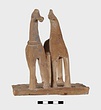
Two animals; handle and mouth break.
ADDENDA:
Hound and hare group, ca. 500-490 B.C., Roebuck, no. 200, ABV. Carl Roebuck, Nb. No. 6.
Well A, Pit A. 31 ... 24 March 1938 ... Two animals; handle and mouth break.
ADDENDA:
Hound and hare group, ca. 500-490 B.C., Roebuck, no. 200, ABV. |
Fragment of discus and rim. Very small bit of rim and start of top of nozzle preserved.
Apparently narrow rim, plain, with a row of large dots round the inner edge.
Discus, concave, with three grooves ... 4 April 1932 |
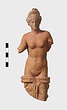
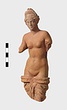
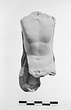
| Nude woman with drapery falling off her hips.
Hands, arms and legs below knees broken off.
No traces of color.
Red clay; somewhat micaceous.
ADDENDA: It is joined with T 1521. Well. Baskets 1-4. Leica, ... 21 April 1937 |
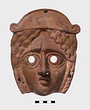
| Several joining fragments preserved most of the face of a nearly-life-sized tragic mask.
Long curls hang at the sides; large holes for the eyes; nostrils pierced; mouth very small. Also three other fragments ... 23 May 1938 |
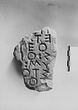
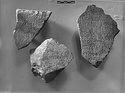
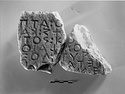
Inscribed fragments from a round monument.
Fragments Β 200a (a) and B 200b (b), broken all around.
The inscribed surface convex.
Fragment Β 259 (c), broken all around.
Part of four lines of the inscription ... Ca. 180 A.D. |
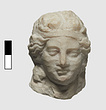
| Broken off at neck.
Head of woman wearing a high diadem. Hair parted in the middle.
Traces of dull red glaze.
Red clay.
ADDENDA: It is joined with T 1469. Κεφάλι από πήλινο ειδώλιο Αφροδίτης. Η μορφή ... 18 May 1937 |
| Somewhat more slender in proportions than P 6302 and P 6303, and with upper body slightly concave. Below handle zone incised groove. In handle zone front and back, ivy tendrils entwined around a thin clay ... 22 May-6 June 1935 |
Handle with part of rim and base.
Trace of signature on base (?).
ADDENDA Parts of two lamps joined by plaster which was removed. Cistern, layer II. Leica ... 1937 |
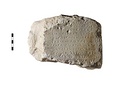
Inscribed fragment of Prytany dedication.
Broken on all sides.
The inscribed surface is convex; four lines of the inscription preserved.
Hymettian marble.
ADDENDA With I 1435 (B 200). Found in late context, ... Ca. 180 A.D ... Hymettian marble.
ADDENDA With I 1435 (B 200). |
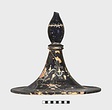
| Black glaze knob for large lid. Broken off at neck and the base missing. Joined to P 18001.
Firm black glaze, rather dull, and with metallic splotches. Around the shoulder, carefully rendered in thinned ... 1939, 1947 |
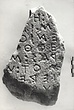
Inscribed fragment.
Right edge preserved; back rough picked.
Pentelic marble.
ADDENDA Joined to I 6170;
Joins I 3025, I 5855. Finished Found in context of late Roman time in plundered foundation trench ... 2nd. century A.D. |
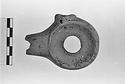
Fragment of nozzle and front. Rounded, wheel made.
Watch-shaped body, merging with rim, broken.
On the left side a large perforated knob. Long nozzle, pointed; chipped.
High base, slightly concave, well ... 10 July 1931 |
| Two joining fragments preserve some of rim and body. Out-turned rim.
On floor, part of a rectangular stamp is preserved.
Brown clay. Dull black glaze.
ADDENDA Fragments added give most of body [July ... Summer 1957 |
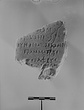
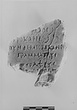
Inscribed fragment.
Inscribed face only preserved.
Eight lines of the inscription preserved; boustrophedon.
Leges sacrae.
Pentelic marble.
ADDENDA With I 2253. Found in the wall of the modern house 650β/4 ... 17 January 1937 |
Inscribed fragment.
Upper surface smooth. Lower roughish, but probably finished.
Broken behind and at both ends.
A single line of letters, directly above which a horizontal groove.
Hymettian marble ... Ca. 200 B.C. |
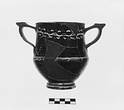
| Outward turned lip. Rim set off by incised lines, one above, two below, with guilloche between. On rim, below an egg and dart, dolphins leaping above wave pattern. On body, between two alternating kinds ... 30 May 1935 |
| Full profile preserved. Missing pieces of floor and rim restored in plaster. Shape as P 14307 (Ω 1091).
Glaze fired irregularly dull brown to black.
ADDENDA P 14307: High base ring; flat down-sloping ... 15 February-2 March 1938 |
| A single fragment preserves most of front of torso and pin-holes for arms.
Brownish-red clay; dark buff at surface.
ADDENDA: Slip preserved over back. Cistern. Container 13.
250-200 B.C. Leica, 77-12-15, ... 12 May 1939 ... Brownish-red clay; dark buff at surface.
ADDENDA: Slip preserved over back ... Container 13.
250-200 B.C. |
Inscribed fragment.
Inscribed face only preserved.
At least five lines of the inscription preserved.
Leges sacrae.
Pentelic marble.
ADDENDA With I 2253. Found in the wall of the modern house 650β/1 (650b/1), ... 26 January 1937 |
| Inscribed fragment.
Broken all around.
Remains of four lines of the inscription.
Pentelic marble.
ADDENDA Joins with I 853. Found in late context, northeast of the Tholos. Leica, XXIII-95 ... 150-200 A.D. |
| Inscribed fragment.
Broken all round.
Part of five lines of the inscription preserved.
Pentelic marble.
ADDENDA Joins with I 1045. Found in late Roman context, east of the Tholos. Leica ... 150-200 A.D. |
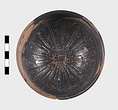
| Fragmentary. Restored in plaster. Similar to P 6232 but deeper and with narrower rim, plain on its inner edge.
Black glaze, badly peeled, and fired metallic silvery at the center of the floor as a result ... 22 May-6 June 1935 |
Inscribed fragment.
Inscribed face only preserved.
Leges sacrae.
Ten lines of the inscription preserved; boustrophedon.
Pentelic marble.
ADDENDA Resembles I 4390.; with I 2253. Found in a wall of the ... 6th. century B.C. |
| Much of rim and wall missing. Deep, small open bowl with downcurving rim; ring foot.
Dull black glaze overall.
ADDENDA ΣΑ 3454. Lot ΣΑ 24. Two joining fragments. They join P 23597. ΣΑ 3454: catalogued ... 27 August 1953
4-6 June 1949 |
| Inscribed fragment.
Inscribed on two faces.
Boustrophedon.
Pentelic marble.
ADDENDA With I 2470, I 4432, I 4390, I 4721, I 5033, I 5318, I 4800. Found in the wall of the modern house 636α/8 [636/8 on ... 22 December 1934 |
Inscribed fragment.
Smooth left side preserved; otherwise broken.
Three lines of the inscription preserved.
Pentelic marble.
ADDENDA Joins with I 1417. Found in late context, south of the Tholos. Leica ... Ca. 200 A.D. or later. |
Inscribed fragment; leges sacrae.
Inscribed face only preserved.
Three lines of the inscription preserved, traces of one more, and one below; boustrophedon.
Pentelic marble.
ADDENDA With I 2253 (?).
Cf ... 16 April 1937 |
| Inscribed fragment.
Inscribed face, rough picked back and picked left side preserved.
Eleven lines of the inscription preserved.
Pentelic marble.
ADDENDA Belongs with I 5897. Found in Byzantine wall southeast ... 175-200 A.D. |
Inscribed fragment.
Right edge and rough picked back preserved.
Six lines of the inscription preserved.
Pentelic marble.
ADDENDA Belong with I 5177. Found in Dark Age context west of the late Roman Fortification, ... 175-200 A.D. |
| Fragment of inscription.
Broken all round, save on inscribed surface.
Temple Inventory.
Hymettian marble.
ADDENDA Part of two other fragments: I 94 and I 647. Found at a late Roman level, north of the ... 200-150 B.C. |
| Inscribed fragment.
Back and right side of stele preserved.
The back rough picked, the side fine.
Decree concerns the demos of Ephesus.
Eleven lines of the inscription preserved.
Hymettian marble.
ADDENDA ... Ca. 200 B.C. |
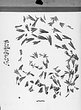
| There are 85 more or less complete leaves, and about 50 fair sized fragments.
The leaves range in length (from 0.03 to 0.066).
Made of thin gold foil, folded and cut in paper doll style, each having ... 17 March 1936 |
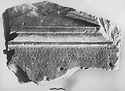
| Fragment of inscribed stele with pediment top.
The right side of the gable preserved; the stone broken away below and on left.
Eleven lines of the inscription preserved.
Hymettian marble.
ADDENDA Belongs ... 238/7 B.C ... Hymettian marble.
ADDENDA Belongs with I 1966 ... Leica, 5-200, VII-79 |
| Inscribed fragment.
Surface slightly pitted from acids of cesspool near which it was found.
Toothed left side preserved; otherwise broken.
Six lines of the inscription preserved; a space between the third ... Ca. 200 B.C. |
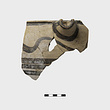
Buff clay, red glaze decoration, Mycenaean.
ADDENDA 2018: Single sherd to a spouted krater with rounded rim.
The exterior decoration consists of a rim band with a wavy band in the handle zone. The lip ... LH IIIC Early |
Inscribed fragment.
Part of smooth left side preserved; elsewhere broken.
Three lines of the inscription preserved, and bits of two letters in a fourth line below.
Pentelic marble.
ADDENDA Joins with ... Ca. 200 A.D. or later. |
| Broken away behind and at the neck.
Head from plastic lamp (?). High headdress, or handle (?) The eyes pierced.
Flaky red glaze over buff clay.
Probably from plastic lamp.
ADDENDA: Negroid head, Mime ... Ca. 200-250 A.D. |
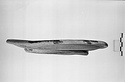
| Lip of nozzle and lower part of infudibulum missing.
The top of the rim is depressed and a broad rim slopes in a concave curve to a large filling hole. Shoulder sharp and wall fairly straight, on left ... 20 July 1931 |
Inscribed fragments.
Inscribed on two adjacent faces.
Leges sacrae.
Fragment ΙΙ 270 a), two adjacent faces preserved; otherwise broken all around.
Boustrophedon.
On face A, six lines of the inscription ... a) (ΙΙ 270) 14 March 1938
b) (ΒΒ 35) 6, 11 October 1938
c) (ΒΒ 85) 19 November 1938 |
| Broken of at the base of neck and behind.
Head of a woman with long wavy hair bound by a fillet.
Roughly smoothed, the final finish had not been given.
Island marble.
ADDENDA H. A. Thompson queries whether ... 20 March 1937 ... Island marble.
ADDENDA H. A. Thompson queries whether the bump over the temples were used for measuring.
... Leica, 7-200 |
Two joining fragments preserve most of the handle, including its lower end. A vertical band handle, moldmade with relief decoration on the outer surface: a herringbone pattern vertically on either side ... 1 March 1934 ... P 22221.
ADDENDA Handle, probably of piriform mug with applied decoration. North African ("Late Roman Red"), ca. 200-250 A.D. [JWH]. |
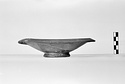
| About half preserved. Similar to P 6234, but very crudely made.
Incised on floor:
The metallic black glaze was put on with a brush after the plate had been taken off the wheel.
ADDENDA P 6234: Large ... card: ca. 200 B.C. |
About half the bottom, surrounded by a double groove, preserved.
Fine pinkish-buff clay, unglazed.
Type XXVII (?) of Corinth collection.
Cf. Corinth IV, ii, pp. 90-102, nos. 545-785, pls. XI-XII, XXVI-XXIX ... 200-250 A.D. |
Four non-joining wall fragments. Glaze brownish and streaky on inside and stops 0.08 from top break on fragment a. Max. dim. a) 0.119, b) 0.069, c) 0.091, f) 0.04.
Men or youths with horse or mule. Fragment ... Ca. 490 B.C ... The figure on fragment c was probably somewhat like the right komast on the Goettingen Painter's namepiece (ARV2 233, ---, 1; Addenda 200). Not from the same krater as 202. 201 has brownish glaze on the inside, 202, black. The presence of the ground line on fragment a would argue that the figures on 202 were framed, were it not for the similar ground line on a contemporary column-krater by Myson that has unframed figures on each side: Louvre CA 1947 (ARV2 240, 44; Paralip. 349, 44; Addenda 201).
Recalls the Goettingen Painter (ARV2 235, ---). |
| Fragment with a spout, buff clay with red black glaze decoration.
ADDENDA 2018: Four sherds mended into a single large spouted krater fragment with horizontal rounded rim.
The exterior decoration consists ... 13-15 June 1938 |
| 92 fragments preserve nearly two-thirds of rim and body, in addition to both lug handles.
A) Four figures: on left, bearded man in profile to right, resting on knotted staff and wearing a mantle. To right, ... 460 B.C ... Attic clay.
ADDENDA Section nos. that belong to this pot: ΒΓ' 173, ΒΓ' 183, ΒΓ' 191, ΒΓ' 192, ΒΓ' 193, ΒΓ' 194, ΒΓ' 195, ΒΓ' 200, ΒΓ' 349, ΒΓ' 515, ΒΓ' 516, ΒΓ' 517, ΒΓ' 518, ΒΓ' 519.
|
Bowl fragment. Max. dim. 0.032; est. diam. of tondo 0.14. H. A. Thompson, Hesperia 28, 1959, pl. 22:a, c.
I, around tondo, stopped-maeander pattern with cross-squares. A, nude man or youth (from the waist ... Ca. 490-480 B.C ... E 268 (ARV2 198, 24; Addenda 191); the youth on Oxford 1924.3 (ARV2 200, 45; Paralip. 342, 45; Addenda 191); the armed youth on Vienna 654 (ARV2 201, 67; Addenda 192); the satyr on New York, M.M.A. 07.286.69 (ARV2 201, 70; Addenda 192); the satyr on Louvre G 185 (ARV2 207, 142; Addenda 194); and the youthful warrior on the stamnos now New York, M.M.A. 1988.40, ex New York, Bastis (ARV2 207, 141; Addenda 194; Antiquities from the Collection of Christos G. ... For the Foundry Painter, the best comparisons are these: the central youth on side A of the namepiece (ARV2 400, 1; Paralip. 370, 1; Addenda 230); the youth in the tondo of London, B.M. ... GR 1850.3--2.2 = E 78; Toledo 64.126 (Paralip. 370, 12 bis; Addenda 231); and Berlin 3198 (ARV2 402, 13; Paralip. 370, 13). |
| Inscribed fragments.
Fragment Ο 231 a), inscribed face only preserved.
Boustrophedon.
Joining fragment ΒΒ 48, smooth left side preserved.
Thirteen lines of the inscription preserved, as joined.
Fragment ... a) (Ο 231) 21 February 1935
(ΒΒ 48) 13 October 1938
b) (ΒΒ 92) 22 February 1939
c) (ΒΒ 158) 20 March 1939 |
Inscribed block.
Fragment Ι 158 a), left side broken; bottom and back picked fairly smooth. The right side has at the corner next the inscribed front, a triangular worked surface which opens out from ... Ca. 200 B.C. |
Wall fragment of stand with part of black band on inside. Glaze flaked here and there. Max. dim. 0.082. LIMC II, 1984, p. 200, no. 85, s.v. Apollon.
Apollo. The fragment preserves the chin, neck, long ... Ca. 460-450 B.C ... LIMC II, 1984, p. 200, no. 85, s.v. ... The figure of Apollo probably looked very much like the representation on the column-krater in Ferrara 1685 = T.308, by the Painter of Bologna 228 (ARV2 511, 5; Paralip. 382, 5; Addenda 252). |
| Inscribed fragments.
Fragment ΘΘ 105 a), inscribed face only preserved.
Six lines of the inscription preserved; boustrophedon.
Fragment ΘΘ 105 b), inscribed face only preserved.
Seven to eight lines ... a-c) (ΘΘ 105 a-c) 16, 16, 17 April 1937
d) (ΘΘ 138) 20 april 1937
e) (ΘΘ 155) 23 April 1937
f) (ΘΘ 206) 12 May 1937
g) (ΑΑ 64) 9 February 1938
h) (ΙΙ 223) 26 February 1938
i) (ΑΑ 244) 6 April 1938
j) (ΙΙ ... |
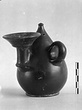
| [Originally identified as Feeder and Rattle (?)]
Lip of spout broken way (found later). Mastos-shaped closed vase with a vertical loop handle and a vertical spout, set an an angle of 90° to one another ... 6 April 1936 |
Five non-joining fragments of shoulder and wall. Glaze dull on outside. Surface of figures rather abraded. Max. dim. a) 0.089, b) 0.077, c) 0.147, d) 0.102, e) 0.092.
Athena and the Giant. Fragment a ... Ca. 490-480 B.C ... E 469 (ARV2 589, 1; Addenda 264; Prange, Niobidenmaler, p. 157, cat. no. ... For the helmet crest with three lines and a row of dots, also the eye with centered pupil, see the warriors on Harvard 1925.30.126 by the painter himself (ARV2 234, 11) and New York, M.M.A. 91.1.462 in his manner (ARV2 234, ---, 1; Addenda 200). |
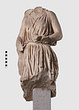
| Missing: head, right forearm and hand, part of left forearm, legs from above knees.
A statue of a young girl approximately one-third life-size, from a high relief.
She wears a long loose chiton, pinned ... 31 May 1938 |
| Parts of rim and nearly a quarter of wall missing; restored in plaster.
A cylindrical drum, tapering around top. Heavy rim, flat on top and sharply profiled; lower wall thickened to form heavy collar ... 28 May-16 June 1938 ... Hard clean pinkish buff clay; black glaze on ridges and on collar at bottom.
ADDENDA
Fuller description of A 957 and A 958, with references. ... Putens; RM (1923-1924), p. 84 f.; RA (1933), I, p. 154 ff.; RA (1935) I, p. 200 ff."
For the description of the chimney-pot, see A 958. |
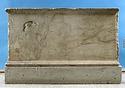
| Inscribed statue base with dedication.
Besides the large piece of the long face, many small fragments were found built into the wall of the modern drain, including one bit with the letters "M H". One fragment ... Second quarter of 4th. century B.C. |
Four non-joining fragments, a -- c of shoulder, d of neck. Glaze misfired slightly on tongue pattern on fragment a. From a very large krater. Max. dim. a) 0.127, b) 0.15, c) 0.089, d) 0.093. G. Schwarz, ... Ca. 460 B.C ... A 2; Schleiffenbaum, Volutenkrater, p. 323, cat. no. V 200; Hayashi, Triptolemosbildes, p. 142, cat. no. 59.
... E 140: ARV2 459, 3; Paralip. 377, 3; Addenda 243), on which the god's name is inscribed just as it is on 238; Athena appears in one of the very earliest examples, Reggio 4001, which is probably by Exekias himself, not in his manner (ARV2 147, 6; Paralip. 61, 6; Addenda 41; Schwarz, p. 29, cat. no. |
|
|