Google Earth

| Inventory Number: | P 9275 | |
| Section Number: | Φ 97 | |
| Title: | Black Figure Stand: Inscribed | |
| Category: | Pottery | |
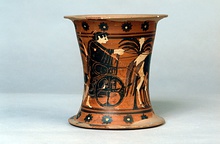
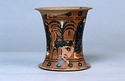
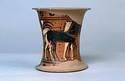
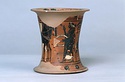
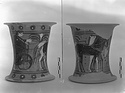
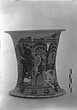
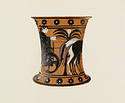
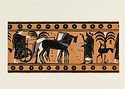
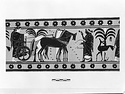
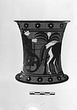
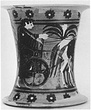
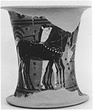
| Description: | Mended from many pieces; most of the lip, about half the base and scattered fragments of the figured scenes missing. A cylindrical stand, open at top and bottom, with a rather concave profile and simple slightly projecting rim and base. Interior: horizontal stripes, alternately black and reserved, varying from ca. 0.01 to 0.02 in width, widest towards the middle. Exterior: above and below, black rosettes with white centers. The figured scene completely encircles the vase and is separated from the rosettes by two black lines. Artemis, right, wearing a long himation, mounts a chariot drawn by four horses which stand beside a palm tree. In front of the horses and facing them stands Apollo in long chiton and himation, holding a seven-stringed lyre (strings incised) in his left hand and a flower in his raised right. Behind Apollo a young deer, left, stands under a second palm tree. The deer and Artemis are back to back. In the field, nonsense inscriptions in glaze: above the backs of the horses, horizontally, Ο Ι Ε; between their legs, vertically, Ο Ρ Ε Ι Ο; between them and Apollo, vertically, Ο Ι Ε Ε Ο Γ [cf. AJA 33 (1929), pp. 361-362, all of which, however, belong to the mid-sixth century]. The added colors are well preserved. White is used for Artemis' flesh; for one of the horses and for decorations on the harness of another; for Apollo's wreath, the frame of his lyre, the visible lower part of his long chiton, and the dots along its lower border; for the throat, chest, belly stripe and tail of the deer; for the hearts of the two palm trees; and for the dots of the rosettes in the borders above and below. Red is used for Artemis' fillet; for crosses and folds on her himation; for four bosses on the chariot car; for the reins; for the tails and manes of the white horse and the nearest black one; for some of the harness; for dots and folds on Apollo's himation; and for the outer edge of the lip of the pot. | |
| Context: | Big well. | |
| Negatives: | Leica, 7-165, 7-166, 7-305, 7-322, color slide | |
| PD Number: | Ptg. 127, Ptg. 140 | |
| Dimensions: | Diam. ca. 0.13; H. 0.134 | |
| Date: | 1 March 1937 | |
| Section: | Φ | |
| Grid: | Φ:61/ΙΖ | |
| Elevation: | Ca. -1.50m. | |
| Masl: | -1.5m. | |
| Deposit: | M 17:4 | |
| Period: | Greek | |
| Bibliography: | Lynch (2007), p. 197, figs. 169A, B. | |
| AgoraPicBk 19 (1980), fig. 14. | ||
| AgoraPicBk 8 (1963), fig. 38. | ||
| Hesperia 7 (1938), p. 342, figs. 24, 25. | ||
| AJA 41 (1937), p. 180, fig. 4. | ||
| ILN (11 September 1937), p. 432, figs. 19, 20. | ||
| Agora XXIII, no. 575, pl. 55. | ||
| Is Similar To: | Agora:Object:AJA 33 (1929), pp. 361-362. | |
| References: | Publications (4) Publication Page: Agora 23, s. 190, p. 174 Publication Page: Agora 23, s. 360, p. 344 Publication Page: Agora 23, s. 454 Report: 1937 Φ Drawing: DA 12666 Drawing: DA 12977 Images (13) Notebook Pages (6) Card: P 9275 Card: P 9275 |
|
Show Everything (374,112) Publications (2,251) Reports (80) Plans and Drawings (11,611) Images (154,235) Objects (47,175) Coins (4,631) Deposits (1,715) Sign in Provide feedback |
|
.png.icon.jpg)
.png.icon.jpg)



.jpg.icon.jpg)
.jpg.icon.jpg)
.jpg.icon.jpg)
.jpg.icon.jpg)
.jpg.icon.jpg)